
AI-powered customer experience marketing (CXM) platform that helps local businesses win.



Every service business owner eventually asks the same question: how many calls should we be handling each day? Understanding the average call center calls per day isn’t just a curiosity metric. It’s the foundation for staffing decisions, technology investments, and growth planning. For SMBs running lean teams, the gap between calls received and calls actually answered often represents thousands in lost revenue each month. SalesCaptain’s AI Phone Agent was built to close that gap, handling unlimited inbound calls around the clock without adding headcount.
What Is Average Call Center Calls Per Day?
This metric measures the total number of inbound and outbound calls a call center or business phone line processes within a single business day. For large enterprise call centers, that number can range from several hundred to thousands of calls daily. But for small and mid-sized service businesses, the reality looks different. A typical SMB might receive anywhere from 20 to 200 calls per day depending on industry, season, and marketing spend.
The number itself only tells part of the story. What matters more is how many of those calls get answered, how quickly, and whether they convert into booked appointments or qualified leads. According to research from Aira, 62% of business calls go unanswered. That’s a staggering figure when you consider that each missed call could represent a customer choosing your competitor instead.
Why This Number Varies So Much
Several factors influence your daily call volume. Seasonal demand plays a major role, especially for home services businesses that see spikes during summer months or after storms. Marketing campaigns drive surges too. If you’re running Google Ads or local SEO, your phone should be ringing more. Yet many businesses invest heavily in lead generation without ensuring someone actually picks up.
Industry benchmarks vary widely. A dental practice might handle 40 to 80 calls daily, while a busy roofing company during peak season could see 150 or more. According to Fit Small Business, the average call center agent handles about 50 calls per day, though this fluctuates based on call complexity and average handle time. For SMBs without dedicated call center staff, even 30 daily calls can overwhelm a front desk team that’s juggling other responsibilities.
The Real Cost of Falling Behind
When your daily call volume exceeds your team’s capacity, the consequences are immediate. Callers hear voicemail or endless ringing and hang up. OnceHub reports that the true cost of a missed call for small businesses extends well beyond the single transaction, factoring in lifetime customer value and referral potential. A plumbing company missing 10 calls a day at an average job value of $300 could be losing $3,000 daily in potential revenue.
How Average Call Center Calls Per Day Works in SalesCaptain
SalesCaptain doesn’t just help you track your average call center calls per day. It helps you handle every single one of them, regardless of volume. Here’s how the system works from the moment a call comes in.
- Incoming call hits your SalesCaptain number. Whether it’s a local or toll-free business number, the call enters your custom call flow. You’ve built this using the drag-and-drop Call Flow builder, so the path is tailored to your business hours, team structure, and service offerings.
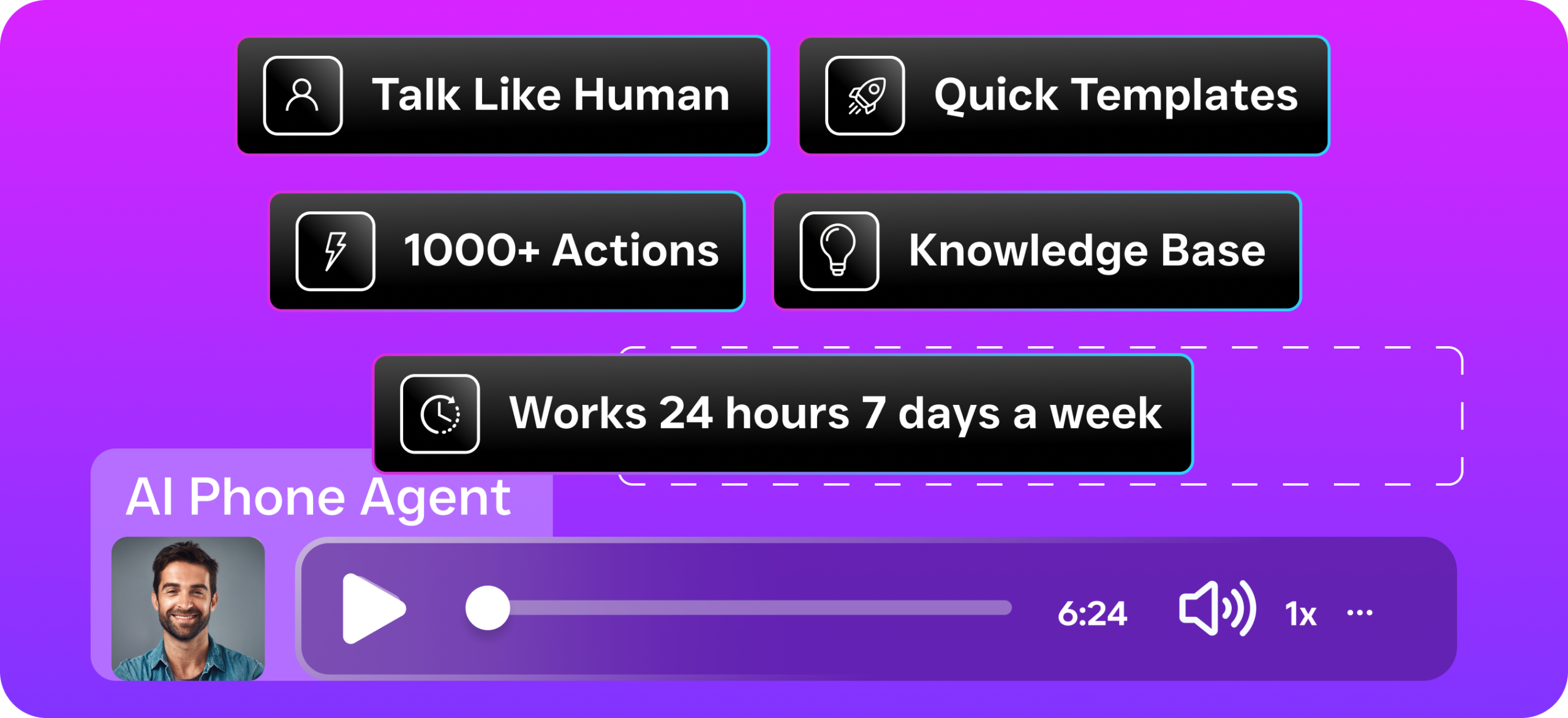
- AI Phone Agent answers instantly. If your team can’t pick up, or if it’s after hours, the AI Phone Agent takes over. It greets callers with a natural-sounding voice, asks qualifying questions, and captures the information you need. No hold music. No voicemail.
- Lead qualification happens in real time. The AI agent determines what the caller needs, whether they’re a new lead or existing customer, and what service they’re requesting. It can answer FAQs about your pricing, availability, and service area without any human involvement.
- Appointments get booked automatically. For callers ready to schedule, the AI agent books directly into your calendar. It checks availability, confirms the time slot, and sends appointment reminders via text.
- Every interaction lands in the Unified Inbox. Call transcriptions, AI summaries, and follow-up notes all appear in one place alongside your texts, webchat messages, and social media DMs. Your team sees the full picture without switching between apps.
- Workflow Automation triggers follow-ups. After the call, automated workflows can send confirmation texts, update your CRM through integrations with HubSpot, Salesforce, or ServiceFusion, and notify your team about high-priority leads.
Key Capabilities
- 24/7 Call Answering Without Staffing Costs, The AI Phone Agent picks up every call, day or night. Unlike hiring additional receptionists or outsourcing to traditional answering services, there’s no per-agent cost and no shift scheduling required. You pay $0.12 per minute of AI call time.
- Spam Blocking and Smart Routing, Not every call deserves your team’s attention. SalesCaptain’s AI filters out spam and robocalls automatically, then routes legitimate callers based on your custom rules. High-value leads can go straight to your best closer while general inquiries get handled by the AI.
- AI Transcription and Summaries, Every call gets transcribed with speaker distinction, and an AI-generated summary pulls out key action items. This eliminates the “I forgot what we discussed” problem and gives managers a fast way to review call quality without listening to full recordings.
- Missed Call Text-Back, When a call does slip through, an automated text goes out immediately. This keeps the conversation alive and brings callers back into your pipeline. According to Scheduling Kit’s missed call statistics, response speed directly correlates with conversion rates.
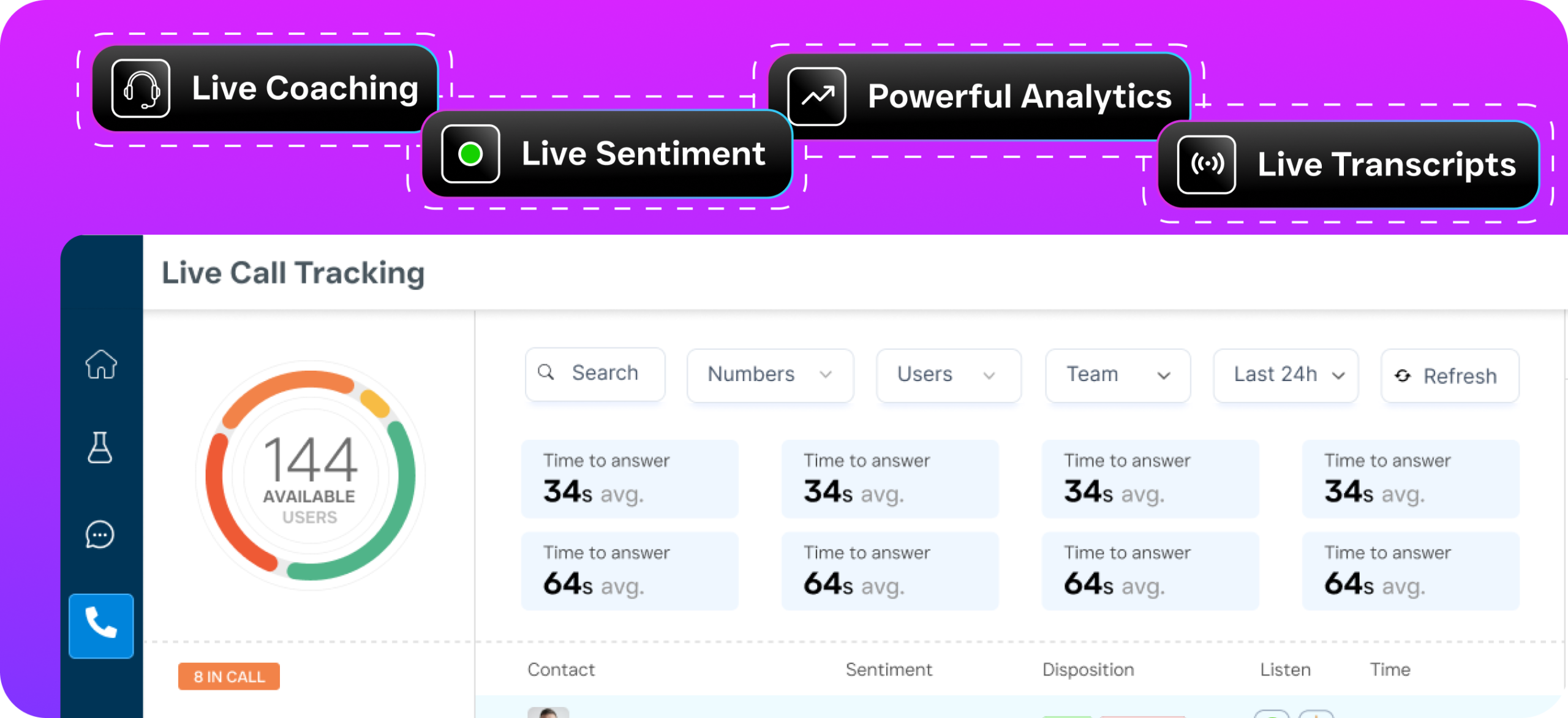
- Real-Time Speech Analytics and Sentiment Analysis, Beyond just handling calls, SalesCaptain analyzes conversations as they happen. Post-call analytics reveal customer sentiment, common objections, and opportunities for training. These insights help you understand not just how many calls you’re handling, but how well.
- Visual Call Flow Builder, Build IVR menus, after-hours routing, voicemail paths, and AI handoffs without any coding. The drag-and-drop interface lets you create call flows that match your exact business needs, then adjust them as call volume patterns change.
Who Needs This?
Any business where phone calls drive revenue should care about daily call volume and answer rates. But some businesses feel the pain more acutely than others.
- Home services companies (roofing, HVAC, plumbing, landscaping), These businesses often see the widest swings in call volume. A single storm can triple daily calls overnight. Having AI backup ensures you don’t lose leads during surges.
- Healthcare and wellness practices (dental, medical, MedSpa, therapy), Patient scheduling drives the business. Every unanswered call is a missed appointment, and many practices lose patients to competitors who simply pick up the phone faster.
- Legal practices, Potential clients calling a law firm are often in urgent situations. They won’t leave a voicemail and wait. If nobody answers, they’re calling the next firm on the list within seconds.
- Salons, gyms, and fitness studios, Appointment-heavy businesses where the front desk staff is already multitasking. Phones ring while they’re checking in clients, and calls get missed constantly.
- Real estate agencies, Buyer and seller leads are time-sensitive. According to Convin’s call center statistics, faster response times dramatically improve lead conversion rates across industries.
- Multi-location businesses (1 to 5+ locations), Operations managers overseeing several locations need consistent call handling everywhere. SalesCaptain’s per-location pricing at $159/month for the Business plan makes this scalable without enterprise-level budgets.
Benefits of Handling More Calls Without More Staff
Revenue Recovery You Can Measure
The most immediate benefit is capturing revenue you’re currently losing. Consider a business receiving 100 calls per day that answers only 60 of them. Those 40 missed calls aren’t just numbers on a report. They’re real customers with real money who went elsewhere. When your AI Phone Agent starts handling 100% of those calls, the revenue impact shows up quickly. Industry data from SkipCalls shows that the cumulative cost of missed calls can exceed six figures annually for growing businesses.
Consistent Customer Experience Across Every Call
Human agents have bad days. They get overwhelmed during high-volume periods, give inconsistent answers, and sometimes transfer callers to the wrong department. SalesCaptain’s AI Phone Agent delivers the same professional experience on call number one and call number one hundred. It never gets frustrated, never puts someone on hold for five minutes, and never forgets to ask for the caller’s email address.
Better Data for Smarter Decisions
When every call is transcribed, summarized, and tagged, you build a dataset that reveals patterns. Maybe you discover that 30% of your calls are the same three FAQ questions, which means your website needs better information. Perhaps you notice call volume drops off sharply after 3 PM, suggesting your ad spend should shift to morning hours. These insights only emerge when you’re capturing and analyzing every interaction, not just the ones your team happens to answer.
Team Productivity Goes Up
Your staff shouldn’t spend their day answering the same questions about business hours and service areas. With AI handling routine inquiries, your team focuses on high-value activities like closing deals, managing projects, and serving customers who are already on-site. Workflow Automation takes this further by triggering CRM updates and follow-up sequences automatically through integrations with tools like HubSpot, Zoho, and HousecallPro.
How SalesCaptain Compares
Most platforms force you to choose between phone features and digital communication tools. SalesCaptain is the only platform that combines an AI voice agent, AI chat agents, and a unified inbox in a single tool built specifically for service businesses.
Take Aircall, for instance. At $30 per license per month, it’s one of the pricier options in the market, yet it doesn’t offer a Voice AI Agent, webchat, email channel, or missed-call text-back. It’s built for sales team call centers, not for a plumbing company that needs to answer calls and book jobs around the clock. SalesCaptain includes real-time AI for calls, payments via text, and a leads form that Aircall simply doesn’t provide.
OpenPhone appeals to startups at $15 per user, but it lacks call coaching, power dialing, sentiment analysis, and voicemail drop. Its AI capabilities are minimal. For a business that needs to handle growing call volume without growing its team, those gaps matter. SalesCaptain also offers call queueing and real-time speech analytics that OpenPhone doesn’t.
Traditional answering services like Smith.ai and Ruby rely on human receptionists, which means per-call pricing that escalates fast as your volume grows. A business handling 100 calls per day would face enormous monthly bills with either service. SalesCaptain’s AI handles unlimited concurrent calls at $0.12 per minute, and the quality stays consistent whether it’s your 10th call or your 200th. As TechnologyAdvice notes in their review of AI answering services, the shift toward AI-powered call handling is accelerating precisely because of these cost and scalability advantages.
| Feature | SalesCaptain | Aircall | OpenPhone | Smith.ai |
|---|---|---|---|---|
| AI Voice Agent | Yes | No | No | No (human only) |
| Missed Call Text-Back | Yes | No | No | No |
| Unified Inbox (all channels) | Yes | No | No | No |
| Call Coaching & Whispering | Yes | Yes | No | N/A |
| Sentiment Analysis | Yes | No | No | No |
| Starting Price | Free plan available | $30/license/mo | $15/user/mo | Per-call pricing |
| Scales with Volume | $0.12/min AI calls | Per-license cost | Per-user cost | Cost rises per call |
Frequently Asked Questions
How many calls does the average call center handle per day?
Large call centers can process thousands of calls daily, but the average call center calls per day for a typical SMB ranges from 20 to 200 depending on industry and season. According to Cirrus Connects’ industry research, individual agents typically handle around 50 calls per day, though this varies based on average handle time and call complexity.
How many calls per hour is considered productive for an agent?
Most benchmarks put a productive agent at 6 to 10 calls per hour for inbound service calls. Outbound calls tend to be faster, averaging 10 to 15 per hour. However, these numbers assume simple calls with short handle times. Complex service calls, like those in legal or healthcare settings, naturally take longer and reduce hourly throughput.
Can SalesCaptain’s AI Phone Agent handle high call volumes?
Yes. Unlike human agents who can only take one call at a time, SalesCaptain’s AI Phone Agent handles multiple concurrent calls simultaneously. There’s no upper limit on daily volume. Whether you receive 20 calls or 2,000, the AI answers every one without hold times or dropped calls.
What metrics should I track beyond daily call volume?
Daily call count is a starting point, but you should also monitor answer rate, average handle time, first-call resolution rate, and conversion rate (calls that become booked appointments or sales). SalesCaptain’s post-call analytics, transcriptions, and AI summaries give you visibility into all of these without manual tracking.
Stop Missing Calls. Start Capturing Every Lead.
Your business shouldn’t lose customers because nobody picked up the phone. SalesCaptain’s AI Phone Agent answers every call, books appointments, and qualifies leads 24/7, so your daily call volume becomes daily revenue instead of daily missed opportunities. Plans start free, and AI calls cost just $0.12 per minute.