
AI-powered customer experience marketing (CXM) platform that helps local businesses win.


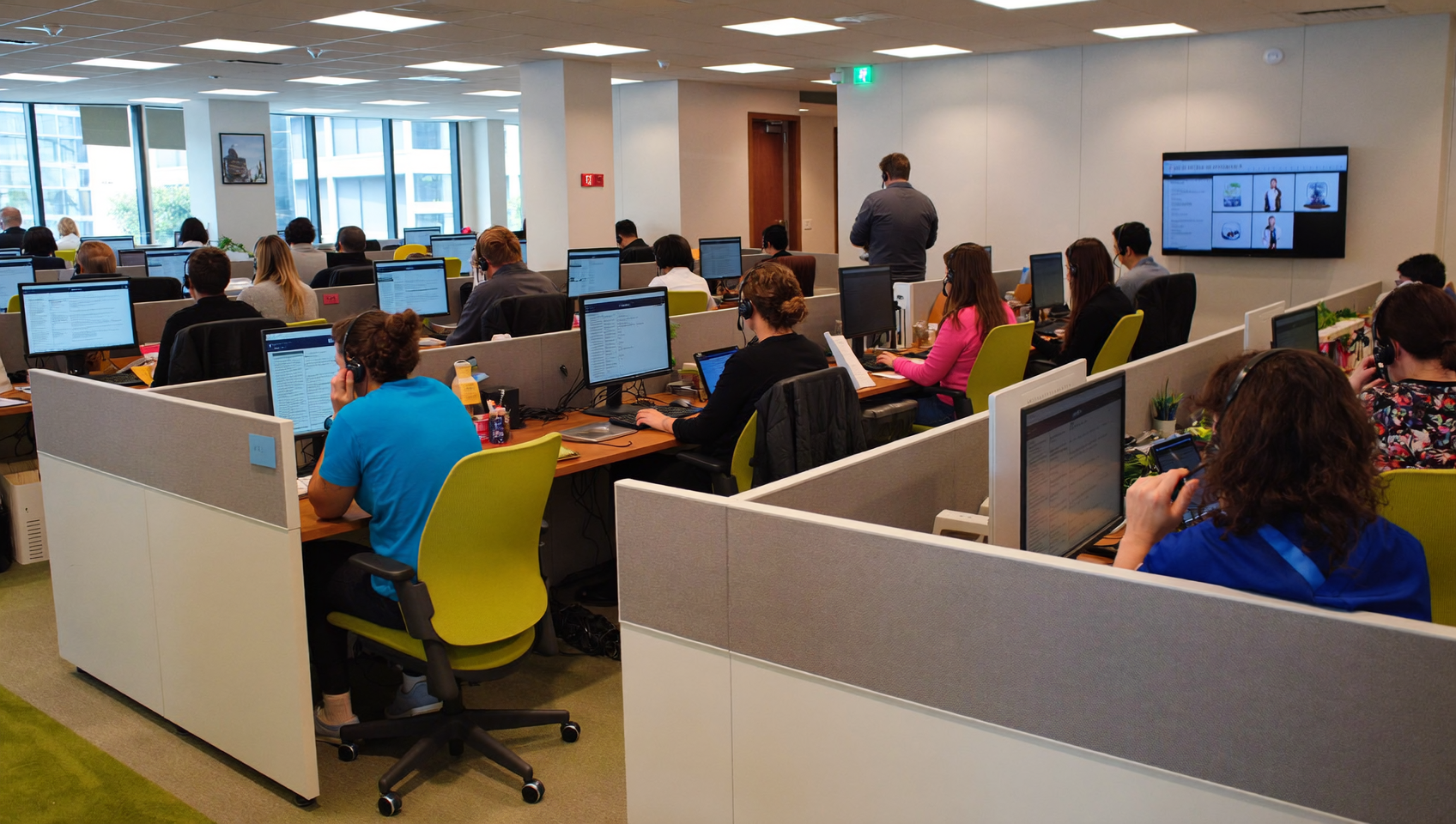
Every missed call is a missed opportunity. For a call center handling dozens or hundreds of interactions each day, knowing how many calls your agents actually manage matters more than most owners realize. Understanding the average calls per day in a call center helps you staff smarter, set realistic expectations, and identify exactly where your operation is bleeding time or money.
Average calls per day in a call center measures the total number of inbound and outbound calls individual agents or entire teams handle during a standard workday. This metric reveals operational capacity and varies by industry, call type, and available tools, helping managers staff effectively and identify efficiency gaps.
Free weekly newsletter
Growth tips for service businesses
Every Tuesday — actionable ideas to get more leads, reviews, and repeat customers. No fluff.
Quick Answer
Most call center agents handle 50-100 calls daily, though this varies significantly based on call type, industry, and agent experience. Inbound support calls average 6-8 minutes, while outbound sales calls run longer at 10-15 minutes. Performance depends on training quality, technology infrastructure, and workload distribution. High-performing centers optimize call routing, reduce hold times, and implement efficient scripts to maximize productive call volume without sacrificing customer satisfaction.
What Does “Average Calls Per Day in a Call Center” Mean?
This metric tracks the total number of inbound and outbound calls an individual agent or an entire call center handles during a standard workday. It’s one of the most fundamental performance benchmarks in customer communication. And the number varies widely. It depends on call type, industry, team size, and the tools your agents use.
For small and mid-sized service businesses, this metric is especially useful. Why? Because it reveals capacity. If your three-person team handles 120 calls a day and you’re growing, you need to know when you’ll hit a wall. That insight shapes hiring decisions, technology investments, and how you structure your call flows.
How Many Calls Does a Call Center Agent Handle Per Day?
There’s no single universal number. But a reasonable baseline sits between 40 and 80 calls per day for a typical inbound call center agent working an 8-hour shift. Outbound agents, particularly in sales, often push higher volumes because outbound calls tend to be shorter and more scripted. Research on sales call volumes by industry shows that outbound reps in some sectors can make over 50 dials per day, while others average closer to 30 when calls involve longer conversations.
Inbound vs. Outbound Differences
Inbound agents typically handle fewer calls per day. Here’s why: each interaction tends to be longer. A customer calling about a billing dispute or service issue might need 8 to 12 minutes, while an outbound cold call might last 2 to 3 minutes. That difference compounds across a full shift. An inbound agent averaging 7-minute calls might handle around 50 calls in a day, while an outbound agent averaging 3-minute calls could complete 80 or more. The math is pretty straightforward.
Hourly Breakdown
Most call center managers think in terms of calls per hour. It’s easier to manage scheduling and breaks that way. A common range is 5 to 12 calls per productive hour, depending on call complexity. But here’s the thing: “productive hour” matters here. Once you subtract breaks, after-call work, meetings, and system downtime, an 8-hour shift typically yields around 6 to 6.5 hours of actual phone time.
| Call Type | Avg. Call Duration | Calls Per Hour | Estimated Calls Per Day (8-hr shift) |
|---|---|---|---|
| Simple inbound (FAQs, routing) | 2-4 min | 10-15 | 70-100 |
| Complex inbound (support, scheduling) | 6-10 min | 5-8 | 35-55 |
| Outbound sales (cold calls) | 2-3 min | 12-18 | 80-120 |
| Outbound sales (warm leads) | 5-8 min | 6-9 | 40-60 |
Keep in mind these are approximations. Your actual numbers depend on factors we’ll cover next.
Factors That Affect How Many Calls a Call Center Agent Can Handle
Raw call volume is only meaningful in context. Two call centers with identical staffing can have drastically different per-agent numbers. Several variables drive the difference.
Call Complexity and Industry
A dental office fielding appointment requests handles very different calls than an HVAC company dispatching emergency repairs. Straightforward calls, like confirming a booking, take a couple of minutes. But troubleshooting calls or calls requiring upselling take much longer. Service businesses like plumbing, legal, and healthcare tend to have more complex conversations, which naturally reduces daily call counts per agent.
Agent Experience and Training
New agents take longer on every call. They pause to look up information, ask colleagues for help, and spend more time on after-call documentation. Experienced agents develop shortcuts and muscle memory. That can cut handle time significantly. According to Harvard Business Review, employee experience directly correlates with customer satisfaction and operational efficiency in service roles.
Technology and Automation
The tools your team uses have an outsized impact. Agents working with outdated phone systems, no CRM integration, and manual note-taking will handle far fewer calls than agents with screen pops, auto-dialers, and AI-powered call summaries. Automation does the repetitive work. That frees your agents to focus on conversations that actually need a human.
After-Call Work
Every call generates follow-up tasks. Logging notes, updating the CRM, sending confirmation texts, scheduling callbacks. This “wrap-up time” typically adds 1 to 3 minutes per call. Reducing it through automation is one of the fastest ways to increase daily call capacity without adding staff.
Channel Mix
Modern call centers don’t just handle phone calls anymore. Agents managing SMS, webchat, and social media messages alongside calls will naturally handle fewer voice calls per day. But their total customer interactions might be higher. The metric you track needs to reflect your actual channel mix.
Best Practices for Improving Agent Productivity and Call Handling
Knowing your baseline is the starting point. Improving it requires deliberate strategy. Here are proven approaches that help service businesses handle more volume without burning out their team.
- Route calls intelligently. Use IVR menus and call flows to send callers to the right person on the first try. Misrouted calls waste time for both the customer and the agent.
- Automate after-call work. AI transcription and summaries eliminate manual note-taking. Automated CRM updates cut minutes off every interaction.
- Deflect simple calls. FAQ-type questions, appointment confirmations, and basic status checks can be handled by AI agents or self-service options, freeing your team for complex calls.
- Monitor key metrics. Track average handle time, first-call resolution, and calls per hour at the agent level. You can’t improve what you don’t measure.
- Reduce hold times. Long hold times don’t just frustrate callers; they consume agent capacity because the call stays “open” even when nothing productive is happening.
- Invest in coaching. Real-time call coaching, where a manager can whisper guidance to an agent during a live call, accelerates learning and improves outcomes without requiring additional calls for follow-up.
One often-overlooked strategy is capturing calls you’re currently missing. Research from Aira’s analysis of missed business call statistics highlights that a significant percentage of business calls go unanswered. For small businesses without dedicated call staff, the cost of each missed call adds up fast, especially for high-value services like legal consultations or home repair estimates.
Metrics That Matter Beyond Call Volume
Daily call count alone doesn’t tell the full story. Pair it with these metrics. You’ll get a complete picture:
- Average Handle Time (AHT): Total talk time plus after-call work, divided by number of calls.
- First Call Resolution (FCR): Percentage of calls resolved without a callback or transfer.
- Abandonment Rate: How many callers hang up before reaching an agent. High rates signal understaffing or slow routing.
- Service Level: Percentage of calls answered within a target time, usually 20 or 30 seconds.
- Occupancy Rate: How much of an agent’s available time is spent on calls vs. idle. Healthy ranges sit between 75% and 85%.
Pushing agents beyond 85% occupancy often leads to burnout. And higher turnover. That’s counterproductive because replacing and training new agents reduces your effective capacity for weeks.
Why a Call Center Businesses Choose SalesCaptain
For service businesses running their own internal call operations, the challenge isn’t just handling more calls. It’s handling them consistently, around the clock, without hiring a full team. That’s where SalesCaptain fits in.
SalesCaptain’s AI Phone Agent answers calls 24/7 with natural-sounding voice AI. It can book appointments, qualify leads, answer FAQs, and route callers based on custom call flows. Every call that would have gone to voicemail at 7 PM or during lunch now gets handled. And the AI doesn’t need breaks, training, or a benefits package.
After each call, SalesCaptain generates AI summaries and transcriptions automatically. This eliminates the after-call work that drags down agent productivity. Your team can review what happened without listening to entire recordings. That alone can save several minutes per call across your daily volume.
The platform’s Unified Inbox pulls calls, texts, webchat, social media DMs, and email into one view. So your team doesn’t waste time switching between apps. For a call center managing multiple channels, that consolidation is a force multiplier. Plus, workflow automation handles follow-up texts, appointment reminders, and CRM updates through a drag-and-drop builder, no coding required.
SalesCaptain integrates natively with tools like leading service business platforms including Housecall Pro, ServiceTitan, and JobNimbus. Compared to options like Aircall, which starts at $30 per license with a three-seat minimum and charges $0.49 per minute for its AI Voice Agent add-on, SalesCaptain’s AI calls run at $0.12 per minute with plans starting free for a single location. For multi-location businesses, per-location pricing at $159 or $300 per month scales without per-seat surprises.
Key Takeaways
The average calls per day in a call center ranges widely. Typically 40 to 80 per inbound agent and 80 to 120 for outbound. But your specific number depends on call complexity, agent experience, and the technology supporting your team. Here’s what to remember:
- Simple calls yield higher daily volumes; complex service calls reduce them significantly.
- After-call work is a hidden capacity killer. Automating it with AI transcription and CRM syncs is the fastest path to more calls per agent.
- Missed calls represent lost revenue. The economics of missed calls are brutal for service businesses that depend on phone-based leads.
- Daily call count is useful but incomplete. Pair it with AHT, FCR, and occupancy rate for a true performance picture.
- AI voice agents can absorb routine call volume 24/7, letting your human agents focus on conversations that require judgment and empathy.
Don’t chase a higher call count for its own sake. Chase better outcomes per call, and use automation to handle the rest.
How many calls should a call center agent handle per hour?
Most agents handle between 5 and 12 calls per productive hour. It depends on call type. Simple inbound queries or short outbound dials push toward the higher end, while complex service or support calls bring that number down. The key variable is average call duration plus wrap-up time.
What is considered high call volume for a call center?
High volume is relative to your staffing and capacity. Generally, when your abandonment rate climbs above 5% or your service level drops below 80% of calls answered within 30 seconds, you’re experiencing high volume relative to your resources. For a small service business, even 50 calls per day with a two-person team can feel overwhelming without the right tools.
How can small businesses handle call center volume without hiring more staff?
AI voice agents and chat automation can absorb routine calls. Think appointment scheduling, FAQ responses, and lead qualification. Workflow automation handles after-call tasks. Together, these tools let a small team manage the call volume of a much larger one. AI receptionist solutions for small businesses have become increasingly accessible and practical for this exact scenario.
Does the industry affect how many calls a call center handles?
Absolutely. A roofing company’s calls involve estimating, scheduling inspections, and discussing project scope. That means longer conversations and fewer calls per agent. A retail customer service line handling order status checks will see much higher daily volumes. Always benchmark against your own industry, not generic call center averages.
What’s the difference between calls handled and calls offered?
“Calls offered” is the total number of calls that reach your system. That includes those that are abandoned, sent to voicemail, or blocked. “Calls handled” counts only the ones where an agent or AI actually connected with the caller. The gap between these two numbers reveals how much business you’re potentially leaving on the table.
Ready to see it in action?
See how call centers use SalesCaptain to handle more calls without hiring additional staff.
See How SalesCaptain Helps a Call Center Handle More With Less
Join a call center businesses already using SalesCaptain to answer every call, automate follow-ups, and free their team from repetitive work. Whether you’re managing 50 calls a day or 500, SalesCaptain’s AI Phone Agent and Unified Inbox give you the capacity to grow without the overhead.