
AI-powered customer experience marketing (CXM) platform that helps local businesses win.


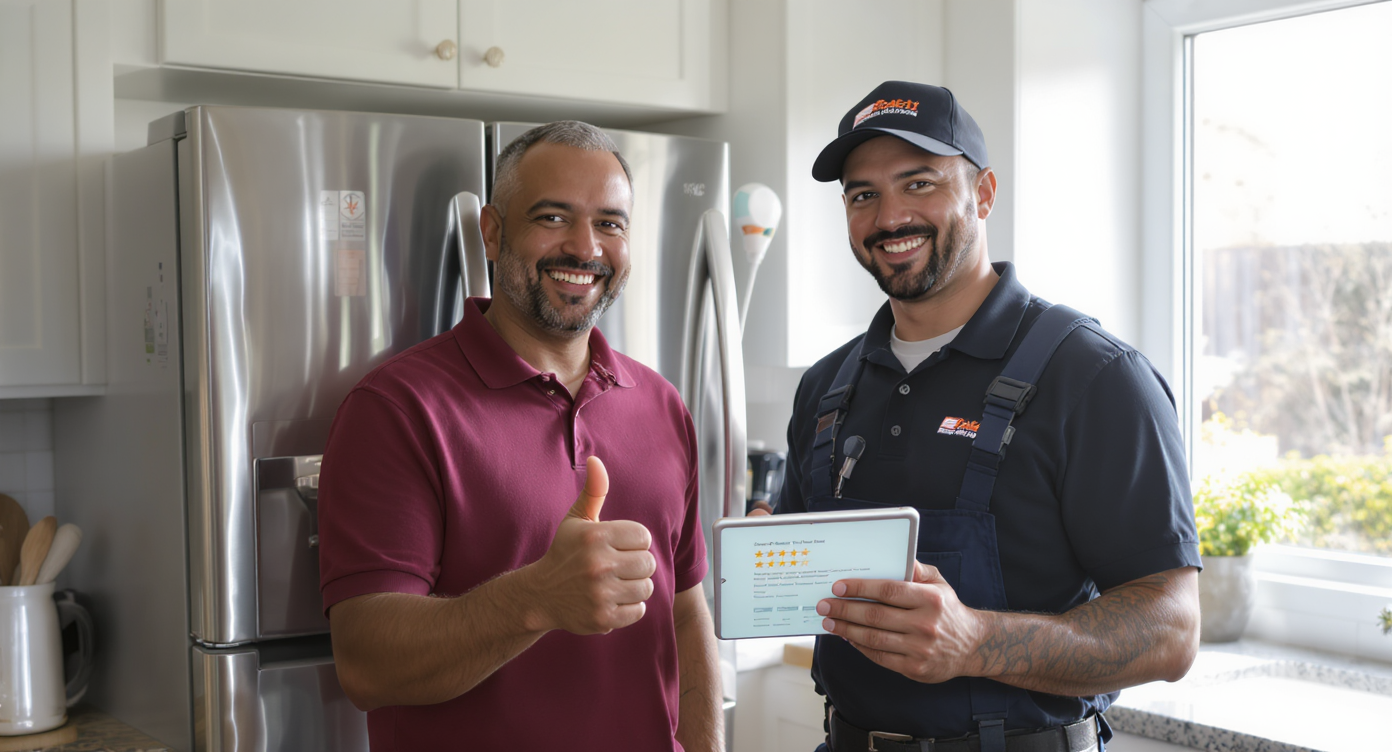
A homeowner’s dishwasher floods the kitchen at 9 PM. They call three appliance repair companies and pick the one with the best Google reviews. Sound familiar? If that’s not you, you just lost the job before you even knew it existed. Learning how to get more reviews for appliance repair companies isn’t a nice-to-have anymore. It’s the difference between a full schedule and an empty one.
Getting more reviews for appliance repair companies means actively requesting customer feedback after service calls and making it easy for satisfied customers to leave ratings online. More reviews improve your Google ranking, attract local customers searching for repair services, and create a cycle where better visibility generates more business and more review opportunities.
Quick Answer
Appliance repair companies get more reviews by requesting them immediately after service completion through text or email, offering incentives like discounts for verified feedback, making it easy with direct links to Google Business Profile, asking satisfied customers in person, and implementing a follow-up system. Consistently delivering quality work and addressing negative feedback professionally also encourages customers to leave positive reviews.
What online reviews Really Mean for Appliance Repair Businesses
Online reviews are public trust signals. When a potential customer searches “appliance repair near me,” Google serves up a local pack of businesses ranked partly by review quantity, quality, and recency. Your star rating acts as a first impression. For most people, it’s the only one that matters before they pick up the phone.
Free weekly newsletter
Growth tips for retail businesses
Every Tuesday — actionable ideas to get more leads, reviews, and repeat customers. No fluff.
But reviews do more than attract clicks. They also feed Google’s local ranking algorithm, which means more reviews lead to better visibility, which leads to more calls, which leads to more reviews. It’s a flywheel effect. According to Biz2Credit’s 2024 small business industry report, home services remains one of the fastest-growing small business sectors, and competition for local customers is intensifying. In that environment, reviews aren’t just reputation management. They’re your most cost-effective marketing channel.
Why Appliance Repair Companies Struggle to Collect Reviews
Most appliance repair businesses don’t have a review problem because of bad service. They have a review problem because of bad timing and missing systems. What does that look like in practice? Here’s what typically goes wrong.
The Forgetting Gap
Your technician finishes a refrigerator repair. The customer is happy. Everyone moves on. Two hours later, nobody remembers to send a review request. By the next morning, the customer’s moved on to other things, and the moment of peak satisfaction has passed. That gap between service completion and review request is where most five-star reviews die.
Making It Too Complicated
Even when you do ask, friction kills follow-through. If a customer has to search for your business on Google, click the right profile, find the review button, and then write something, you’ve lost most of them. Every extra step reduces your conversion rate. The businesses collecting the most reviews? They’ve reduced the process to a single tap on a link sent via text.
No Consistent Process
Some technicians ask for reviews. Others don’t. Some weeks you remember to follow up. Other weeks, you’re buried in service calls. Without a repeatable system, your review count grows sporadically. Meanwhile, competitors with automated follow-ups collect reviews on every single job.
📺 Watch: How to Automate Review Requests After a Job
Proven Strategies to Get More Five-Star Reviews
Getting more reviews requires great service, smart timing, and simple technology. None of these steps are complicated on their own. But combining all of them creates a compounding effect that separates top-rated businesses from everyone else.
Deliver a Review-Worthy Experience First
No amount of automation can fix mediocre service. Before you focus on collecting reviews, make sure you’re giving customers something worth writing about. That starts well before the technician arrives at the door.
- Answer every call promptly. According to research from Aira, a significant percentage of business calls go unanswered. Each missed call is a missed review opportunity, because a customer who can’t reach you will never become a customer who reviews you.
- Set clear expectations. Confirm appointment windows via text. Let customers know who’s coming and when. Proactive communication reduces anxiety and increases satisfaction.
- Follow up after the job. A quick “Is everything working well?” message shows you care beyond the invoice. It also opens a natural window to request a review.
Ask at the Right Moment
Timing matters more than wording. The best moment to request a review is within 30 minutes of job completion. That’s when the customer still feels the relief of a working appliance. Research consistently shows that review request timing correlates directly with response rates.
Send the request via SMS, not email. Text messages have dramatically higher open rates than email. And for a homeowner who just had their washing machine fixed, tapping a link on their phone feels natural. A simple message works: “Thanks for choosing [Your Company]! If you’re happy with the repair, we’d really appreciate a quick Google review. Here’s the link: [direct link].”
Reduce Friction to One Click
Your Google review link should drop the customer directly into the review writing interface. Google provides a short URL for this through your Google Business Profile. Don’t send people to your website and hope they find the review page. Send them straight to the form.
Also consider adding QR codes to invoices, technician business cards, and follow-up emails. Multiple touchpoints increase the odds that at least one catches the customer at the right moment.
Respond to Every Review You Receive
Responding to reviews, both positive and negative, signals to future customers that you’re engaged and accountable. It also signals to Google that your profile is active, which can help with local rankings.
For positive reviews, keep your response genuine and specific. Mention the type of repair or the technician’s name when possible. For negative reviews, respond professionally and offer to resolve the issue offline. How you handle criticism often matters more to prospective customers than the criticism itself.
Don’t Offer Incentives That Violate Platform Policies
Google’s review policies explicitly prohibit offering money, discounts, or free services in exchange for reviews. Violating this can get your reviews removed or your profile penalized. Instead, focus on making the ask easy and well-timed. You don’t need to bribe people for reviews. You just need to ask the right customers at the right time with the least possible friction.
Building a Review System That Runs Without You
Manual review collection doesn’t scale. If you’re running a growing appliance repair company with multiple technicians handling a dozen jobs per day, you can’t rely on memory. You need automation.
Automate the Post-Service Text
The most effective review systems trigger a text message automatically when a job is marked complete in your scheduling software. No human has to remember. No technician has to awkwardly ask in person. The message goes out consistently, every time, for every job.
This kind of automation is where many businesses hit a wall. They’re juggling a phone system, a CRM, a scheduling tool, and a separate texting platform. When these tools don’t talk to each other, things fall through the cracks. According to SkipCalls research, small businesses lose significant revenue annually from missed calls alone. Missed follow-ups add to that loss in ways that are harder to measure but equally damaging.
Use After-Hours Communication to Capture More Opportunities
Appliance emergencies don’t follow business hours. A broken refrigerator at 10 PM generates urgent calls, and if nobody answers, that customer goes to a competitor. Even if you can’t dispatch a technician immediately, capturing the call and responding automatically keeps the customer in your pipeline. According to research on the cost of missed calls, businesses that fail to answer after-hours calls lose a substantial portion of potential revenue. Every one of those lost calls is also a lost review.
Showcase Your Best Reviews
Once you’ve built a strong review profile, put it to work. Feature five-star reviews on your website, in social media posts, and in follow-up emails. Small business data from the U.S. Census Bureau shows that trust and reputation are among the top factors driving consumer choice for local service providers. Displaying real customer feedback reinforces that trust before a prospect even calls you.
How SalesCaptain Helps
Collecting more reviews consistently requires two things: never missing a customer interaction, and automating the follow-up. SalesCaptain handles both.
With the AI Phone Agent, your appliance repair business answers every call 24/7, even at 2 AM when a customer’s oven stops working. The agent books appointments, qualifies leads, answers FAQs, and blocks spam. No call goes unanswered, which means no potential review is lost because a customer couldn’t reach you.
After the job is done, SalesCaptain’s Workflow Automation builder lets you trigger automatic review request texts based on job completion. The drag-and-drop interface requires no technical expertise. Set it up once, and every completed repair generates a review request without anyone on your team lifting a finger. These workflows integrate with tools you’re already using, including HousecallPro, ServiceFusion, and Zapier, so your existing scheduling software can trigger the automation directly.

Your Unified Inbox pulls all customer communication into one place. Calls, texts, webchat messages, and social media DMs appear in a single view, so your team can monitor review-related conversations alongside everything else. If a customer responds to a review request with a question or concern, you’ll see it immediately and can address it before it becomes a negative review instead of a positive one.
For multi-location appliance repair businesses, SalesCaptain’s per-location pricing keeps costs predictable as you scale. The Business plan runs $159 per month per location. There’s also a free Startup plan for single-location shops that want to test the platform before committing.
Key Takeaways
Getting more reviews for your appliance repair company comes down to three principles: deliver great service, ask at the right time, and remove all friction from the process. Here’s the summary.
- Answer every call, especially after hours. You can’t get a review from a customer you never spoke to.
- Send review requests via text within 30 minutes of job completion. Timing is everything.
- Use a direct Google review link that drops customers straight into the review form. One tap, done.
- Respond to all reviews publicly. It improves your ranking and shows prospective customers you’re responsive.
- Automate the entire process so it runs consistently without relying on memory or individual effort.
- Showcase your best reviews across your website and social channels to build trust before the first call.
Reviews compound over time. The appliance repair companies dominating local search today aren’t necessarily better at fixing refrigerators. They’re better at turning satisfied customers into visible proof of good work. Build the system, run it consistently, and your review count will take care of itself.
Frequently Asked Questions
How many reviews does an appliance repair company need to rank well on Google?
There’s no magic number, but your goal should be to consistently outpace your nearest local competitors. If the top-ranked appliance repair business in your area has 80 reviews, aim for 100. Google values recency too, so a steady stream of new reviews matters more than a large total that stopped growing six months ago.
Should I ask every customer for a review?
Yes, with one caveat. If you know a customer had a poor experience that hasn’t been resolved, address the issue first. For everyone else, a consistent, automated request after every completed job is the most reliable approach. You’ll be surprised how many people are willing to leave a review when you simply make it easy.
What should I do about negative reviews?
Respond professionally and quickly. Acknowledge the concern, apologize for the experience, and offer to resolve it offline. Don’t argue publicly. Prospective customers reading your response are evaluating how you handle problems. A thoughtful reply to a one-star review often builds more trust than the review itself destroys.
Is it okay to offer a discount in exchange for a Google review?
No. Google’s terms of service prohibit incentivized reviews. If caught, your reviews can be removed and your profile penalized. Focus instead on making the review process effortless and asking at the moment of highest customer satisfaction.
How quickly should I follow up after a repair to ask for a review?
Within 30 minutes of job completion is ideal. Customer satisfaction peaks right after a successful repair. And it declines rapidly as time passes. Automated text messages triggered by job completion in your scheduling software ensure you hit that window every time without relying on your technicians to remember.
Ready to see it in action?
See how appliance repair companies use SalesCaptain to automatically collect more customer reviews.
Book a Free Demo →See How SalesCaptain Can Help
Stop losing reviews to missed calls and forgotten follow-ups. SalesCaptain’s AI agents and automated workflows make sure every appliance repair job turns into a review opportunity.