
AI-powered customer experience marketing (CXM) platform that helps local businesses win.


phone system for home service businesses
If you run a roofing company, plumbing shop, HVAC business, or landscaping crew, your phone is your lifeline. That ring could mean a $5,000 job or a loyal customer who needs help right now. Yet most home service businesses still rely on personal cell phones, outdated landlines, or basic answering services that drop the ball when it matters most. A purpose-built phone system for home service businesses changes everything. You get professional call handling, 24/7 availability, and the automation you need to stop losing revenue to missed calls and slow follow-ups.
Here’s the reality: your technicians are in the field, your office staff is juggling dispatching and billing, and calls keep coming in at all hours. Sound familiar? According to industry data from SkipCalls, small businesses lose over $26,000 per year from missed calls alone. For home service companies where a single job can be worth hundreds or thousands of dollars, every unanswered call is money walking out the door. This page breaks down exactly what a modern phone system looks like, how SalesCaptain delivers it, and why it matters for your bottom line.
What Is a Phone System for Home Service Businesses?
A phone system for home service businesses is a cloud-based communication platform designed to handle how contractors, technicians, and service providers actually interact with customers. Unlike generic office phone systems built for desk workers, it accounts for reality: most of your team is mobile, calls come in outside business hours, and speed-to-lead determines whether you win or lose. It combines business phone numbers, call routing, voicemail, and in modern systems, AI-powered answering to make sure no opportunity slips through the cracks.
Traditional landline systems are dying fast. Randercom’s analysis of business phone trends highlights the accelerating shift toward IP-based and cloud phone systems, driven by lower costs, better features, and the inevitable sunsetting of copper infrastructure. For home service businesses, this shift is huge. You can get enterprise-grade call handling without enterprise-grade complexity or pricing. Features like IVR menus, call recording, and automated routing used to require expensive PBX hardware. Now? They’re accessible from any smartphone or computer.
But the best systems go further. They integrate with the tools you already use, service management platforms like ServiceFusion and HousecallPro, CRMs like HubSpot and Zoho, so every customer interaction feeds directly into your workflow. When a customer calls about a clogged drain at 9 PM, the system doesn’t just take a message. It captures the lead, qualifies the request, and books the appointment before they call your competitor instead.
How a Phone System for Home Service Businesses Works in SalesCaptain
SalesCaptain was built from the ground up for service businesses. The phone system reflects that focus in every detail. Here’s exactly how it works from setup to daily operation.
Step 1: Set Up Your Business Phone Numbers
You start by choosing a local or toll-free business number, or porting your existing number so customers never notice a change. SalesCaptain’s phone system runs on cloud infrastructure with 99.99% uptime and crystal-clear audio quality. Call quality matches or exceeds what you’d get from a traditional landline. Have multiple locations? Each location gets its own number and settings, all managed from one dashboard. This per-location approach keeps things organized without creating separate accounts for each branch.
Step 2: Build Your Call Flow and IVR
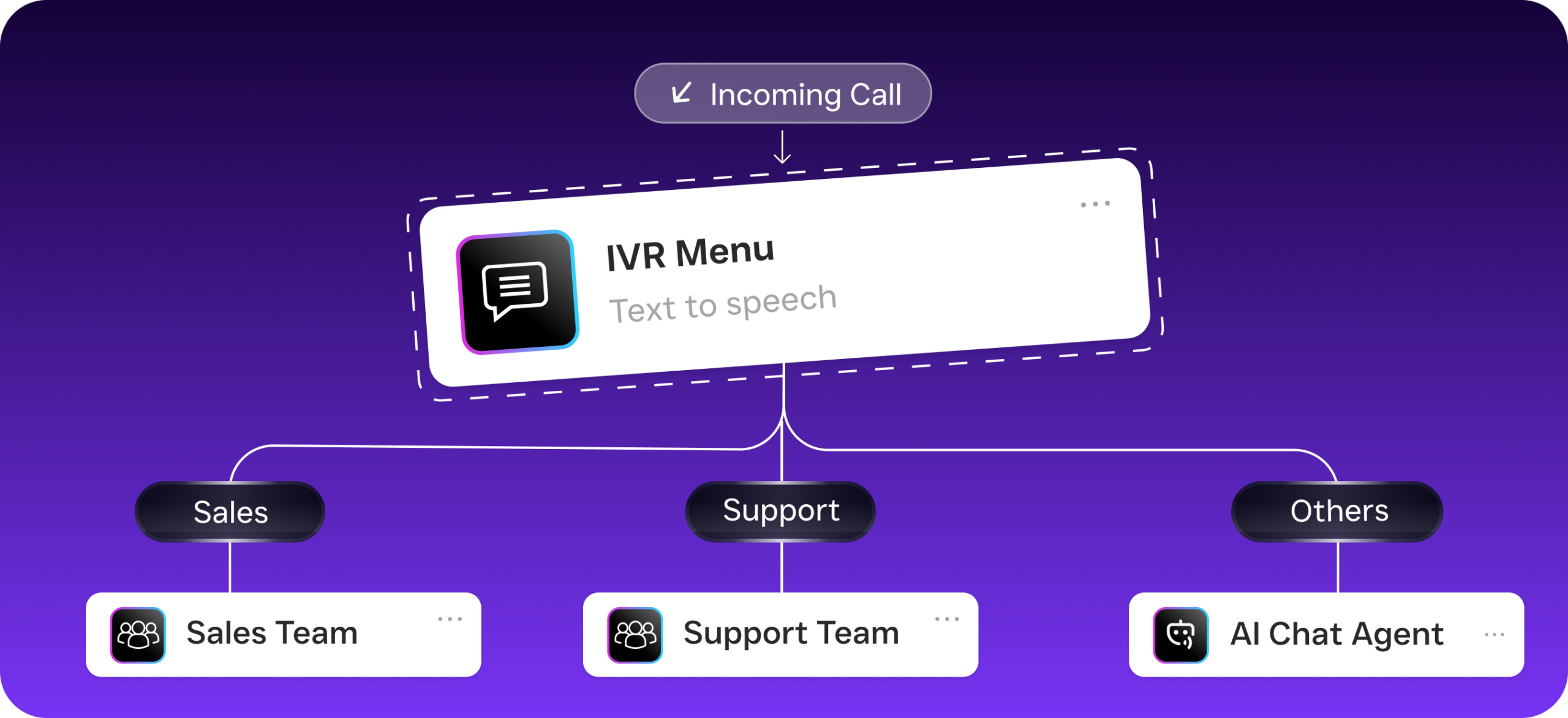
SalesCaptain’s IVR builder lets you create a custom call routing tree that fits your operation. A roofing company might route “emergency leak repair” calls directly to an on-call technician, while “new project estimate” calls go to the sales team or an AI agent. You set business hours, after-hours behavior, and overflow rules so every scenario is covered. The drag-and-drop interface requires zero technical expertise. If you can use a smartphone, you can build a call flow in minutes.
Step 3: Deploy Your AI Phone Agent
This is where SalesCaptain fundamentally differs. You configure an AI Phone Agent that answers calls with a natural-sounding voice, handles common questions like pricing ranges, service areas, and hours of operation, qualifies leads by asking the right questions, and books appointments directly into your calendar. The AI agent works 24/7. Nights, weekends, holidays, your business never goes to voicemail when a homeowner has a burst pipe at 2 AM. It also blocks spam calls automatically, saving your team from wasting time on robocalls and telemarketers.
Step 4: Connect Your Existing Tools
SalesCaptain integrates natively with over 50 platforms. For home service businesses, that includes HousecallPro and ServiceFusion for dispatching and job management, QuickBooks for invoicing, and CRMs like HubSpot, Salesforce, or Zoho. When a call comes in and the AI books an appointment, that data flows directly into your service management tool. No double entry. No sticky notes. No leads lost in transit. You can also connect via Zapier if you use a tool that doesn’t have a native integration.
Step 5: Monitor Everything From One Inbox
Every call, text, voicemail, webchat, and social media message lands in SalesCaptain’s Unified Inbox. Your office manager sees the full history of every customer interaction without switching between apps. Call recordings are stored and accessible, if a technician needs to review what the customer described, it’s one click away. Real-time tracking shows you exactly how many calls came in, how many were handled by AI versus staff, and where your leads are coming from. That data helps you make smarter decisions about marketing spend and staffing.
Key Capabilities of SalesCaptain’s Phone System for Home Service Businesses
Understanding the full scope of what’s available helps you see whether this system addresses your specific challenges. Here’s what actually matters for contractors and service providers.
24/7 AI Call Answering: A natural-sounding AI Phone Agent picks up every call, regardless of time or day. It greets callers professionally, answers frequently asked questions about your services, and never puts anyone on hold. This eliminates the biggest source of lost revenue for home service businesses: unanswered calls during off-hours or peak busy periods. Appointment Booking: The AI agent checks your calendar availability in real time and books appointments during the call itself. Customers confirm their time slot before hanging up, dramatically reducing the back-and-forth that typically delays scheduling by hours or days. Lead Qualification: Before booking or routing a call, the AI asks qualifying questions: type of service needed, property location, urgency level, budget range. Your team only spends time on leads that are a genuine fit. Emergency jobs get flagged immediately. Spam Call Blocking: Automated detection filters out robocalls, telemarketers, and spam before they reach your team. For businesses that receive dozens of junk calls daily, this alone saves meaningful hours each week. Custom IVR and Call Routing: Build multi-level phone menus that direct callers to the right department, technician, or AI agent based on their selection. Route by location, service type, time of day, or any other criteria that fits your operation. Missed Call Text-Back: If a call can’t be answered, even by the AI agent, an automated text is sent within seconds, keeping them engaged instead of moving to a competitor. This AI Chat Agent feature bridges the gap between a missed call and a booked job. Call Recording and Voicemail: Every call is recorded and stored for training, quality assurance, and dispute resolution. Voicemail messages are captured and transcribed, so your team can scan written summaries instead of listening to every message. Workflow Automation: Trigger automated follow-up sequences based on call outcomes. If a caller requested an estimate but didn’t book, a follow-up text goes out the next day. If an appointment is booked, a confirmation and reminder sequence fires automatically. Multi-Location Support: Each business location gets its own phone number, call flows, and AI agent configuration. Everything is managed from a single account. This is critical for home service companies expanding into new territories.
Who Needs a Phone System for Home Service Businesses?
Not every business needs the same communication setup. But if your company matches any of these profiles, you’re likely leaving money on the table. Research from Aira on missed call statistics shows that industries with high-value, time-sensitive customer requests, which describes virtually every home service vertical, suffer most from inadequate phone systems.
Contractors and Skilled Trades
Roofers, plumbers, electricians, and HVAC technicians spend their days on job sites. They’re not sitting by a phone. When a homeowner calls about a broken furnace in January, they need an answer now, not a callback tomorrow. These businesses benefit most from AI-powered answering because their team is physically unable to take calls during working hours. Yet those calls represent their entire pipeline. The combination of 24/7 AI answering and missed call text-back ensures no lead disappears while you’re on a roof or under a sink.
Landscaping and Outdoor Services
Seasonal businesses face extreme call volume fluctuations. A landscaping company might receive three times more calls in April than in December. Hiring temporary staff for the spring rush? Expensive and unreliable. An AI phone agent scales instantly. It handles 10 calls a day or 100 with the same consistency, so you capture every seasonal opportunity without overstaffing. The U.S. Small Business Administration notes that managing cash flow through seasonal peaks and valleys is one of the top challenges for small service businesses, making scalable solutions particularly valuable.
Appliance Repair and Property Maintenance
These businesses thrive on urgency. A refrigerator dies. A water heater bursts. The customer calls the first company they find and books whoever answers. Response time isn’t a nice-to-have. It’s the entire competitive advantage. An AI agent that answers on the first ring, qualifies the issue, and books the appointment within the same call gives you a decisive edge over competitors who rely on voicemail and morning callbacks.
Multi-Location Service Companies
Expanding beyond your original territory creates a communication nightmare: different phone numbers, inconsistent staff answering, no centralized view of customer interactions. SalesCaptain’s per-location structure solves this. Individual numbers and settings for each location, all feeding into one Unified Inbox. Owners and operations managers see everything in one place without logging into separate systems for each branch.
Benefits of a Modern Phone System for Home Service Businesses
The outcomes of switching from a basic phone setup to an AI-powered system are measurable. Here’s what home service businesses actually experience after deploying SalesCaptain.
Recover Revenue From Missed Calls
According to SchedulingKit’s analysis of missed call revenue loss, the average small business misses a significant portion of incoming calls. The vast majority of those callers never try again. For a plumbing company where the average job is worth $300-$500, capturing even a handful of additional calls per week translates to thousands in recovered monthly revenue. Why does this matter? The math is straightforward: if your phone system costs $159 per month and captures one additional job per week, the ROI is immediate and substantial.
Grow Without Hiring More Office Staff
The traditional answer to “we’re missing too many calls” is “hire a receptionist.” But that’s $35,000-$45,000 per year in salary plus benefits. For a small service business, that’s a significant fixed cost. An AI Phone Agent handles the repetitive 80% of calls: scheduling, service area questions, pricing inquiries, hours of operation. Complex or high-value calls route to your human team. You add capacity without adding headcount, keeping your overhead lean as you scale. SalesCaptain’s AI calls are priced at $0.12 per minute. The cost comparison with a full-time employee is dramatic.
Deliver a Professional Customer Experience
Homeowners judge your entire company by that first phone call. A personal cell phone with road noise in the background? A generic voicemail greeting? A 4-hour callback time? That signals “small and unreliable,” even if your work quality is excellent. A professional IVR, instant AI answering, and automated appointment confirmations signal a company that has its act together. This perception gap influences which contractor gets the job far more than most business owners realize. The National Federation of Independent Business consistently ranks customer experience and reputation as top drivers of small business growth.
Centralize Communication Across Every Channel
Your customers don’t just call anymore. They text. They message on Facebook. They fill out web forms. They send Instagram DMs. Without a centralized system, these conversations live in separate apps on different team members’ phones. Context gets lost constantly. SalesCaptain’s Unified Inbox pulls every channel into one view: calls, SMS, webchat, social media DMs, and email. Whoever handles the customer next has the full picture. This eliminates the “I didn’t see that message” problem that costs service businesses repeat customers.
How SalesCaptain Compares to Other Phone System Options
Home service businesses typically evaluate several categories of phone solutions. Understanding the differences saves you from investing in the wrong platform. The small business phone systems market is growing rapidly, which means more options and more confusion about what actually fits a service business.
Traditional Landlines and POTS Lines
Copper-based phone lines are being phased out across the country. Their limitations are severe: no mobility, no automation, no integration with service management tools, and rising costs as carriers sunset the infrastructure. They offer none of the AI capabilities, call routing flexibility, or multi-channel communication that modern service businesses need. Perceived reliability? Cloud systems with 99.99% uptime match that advantage.