
AI-powered customer experience marketing (CXM) platform that helps local businesses win.


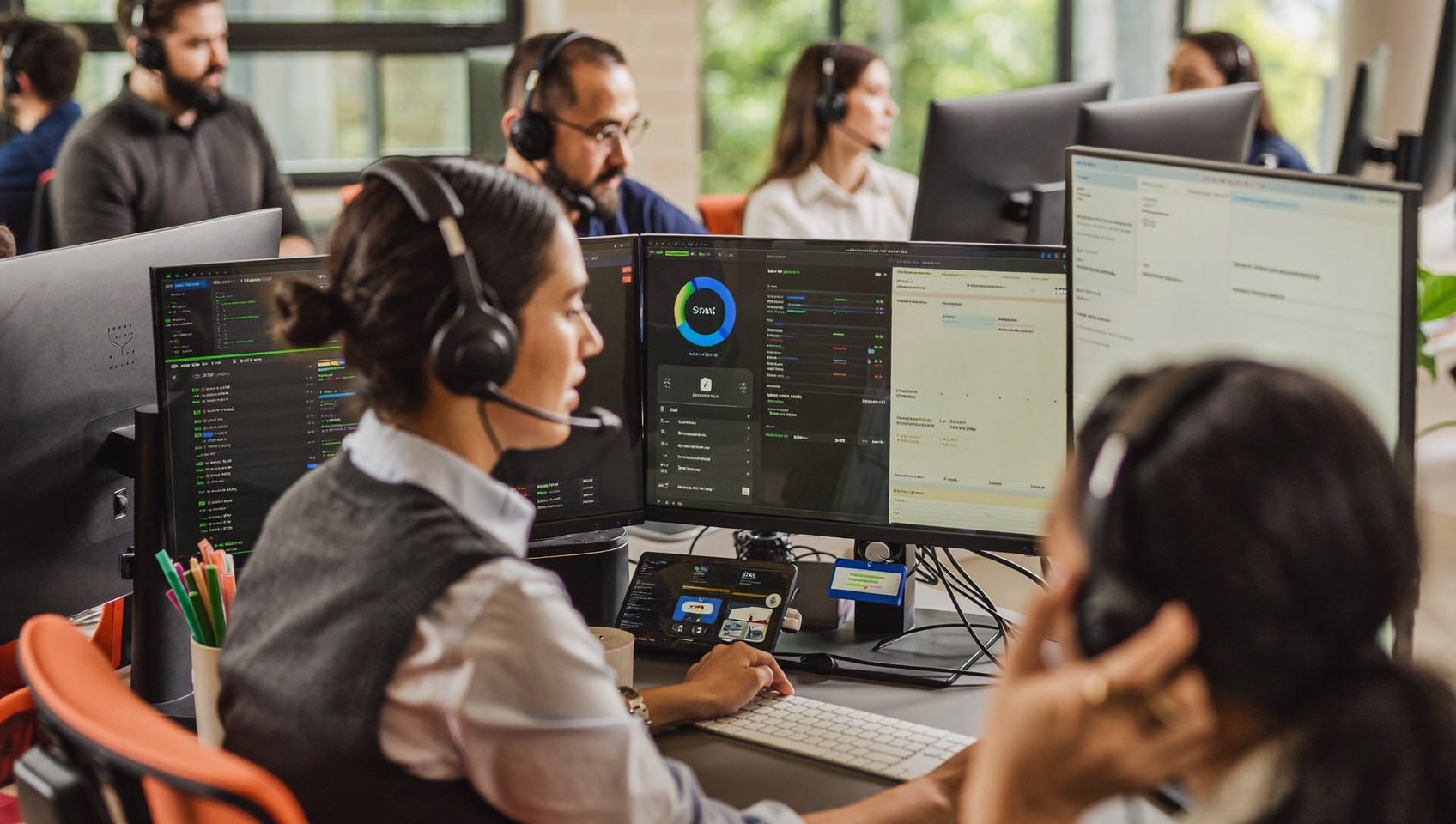
Understanding the average call centre calls per day isn’t just trivia. It shapes staffing decisions, technology budgets, and how many customers you keep. For service businesses on tight margins, knowing your daily call volume—and what to do about it—is the difference between growth and stagnation. SalesCaptain’s AI Phone Agent exists for this reason: to handle the call volume your team can’t, around the clock, without adding headcount.
Average call centre calls per day measures total inbound and outbound calls processed daily, typically per agent. A standard inbound agent handles 40-80 calls daily depending on complexity and industry, while outbound agents may reach higher volumes. This metric reveals capacity, efficiency, and operational performance across phone-dependent businesses.
Free weekly newsletter
Growth tips for service businesses
Every Tuesday — actionable ideas to get more leads, reviews, and repeat customers. No fluff.
Quick Answer
Most call center agents handle 30-80 calls daily, depending on call length and complexity. Inbound support centers average 50-60 calls per agent per day, while outbound operations typically see 40-100 calls. These benchmarks vary significantly based on industry, call duration, scripts, and automation tools used for call routing and documentation.
What Is Average Call Centre Calls Per Day?
This metric measures total inbound and outbound calls a call center processes daily, typically per agent. It’s one of the most fundamental performance indicators in any phone-dependent operation. It reveals capacity, efficiency, and revenue exposure all at once.
Industry benchmarks vary widely. According to recent call center statistics and trends, a typical inbound agent handles between 40 and 80 calls per day, depending on call complexity and industry. Outbound agents might push 60 to 100 calls daily with a power dialer. But here’s the thing: these numbers tell only part of the story.
Factors That Shape Daily Call Volume
Several variables determine how many calls your business actually processes each day. Some you control. Others you don’t.
- Average handle time (AHT): Longer calls mean fewer total calls per agent. A dental office scheduling appointments might average 3 minutes per call, while an HVAC company troubleshooting a furnace issue might average 7 minutes.
- After-call work: Notes, CRM updates, and follow-up tasks eat into available talk time. Without automation, agents spend 20-30% of their shift on post-call tasks instead of answering the next call.
- Staffing levels and shift coverage: A business open 8 hours with two staff members has a fundamentally different capacity ceiling than one with 10 agents across staggered shifts.
- Call complexity: Simple appointment confirmations take 90 seconds. Complex service inquiries or sales qualification calls take 10 minutes or more. Your mix of call types directly determines throughput.
- Technology stack: Businesses using IVR, call routing, and AI-powered answering handle significantly more daily volume than those relying on a single ringing phone line.
For small and mid-sized service businesses, the real issue isn’t maximizing calls per agent. It’s the calls nobody answers. According to research on the true cost of missed calls, small businesses miss a substantial percentage of incoming calls. And each missed call can represent hundreds of dollars in lost revenue.
How SalesCaptain’s AI Phone Agent Handles Your Daily Call Volume
Rather than hiring more staff to keep up with rising call counts, SalesCaptain lets you deploy an AI Phone Agent that processes calls like a trained receptionist would—but without breaks, sick days, or shift limits. Here’s how it works:
- Set up your AI Phone Agent: Choose a business phone number (or port your existing one), then configure your agent’s voice, greeting, and knowledge base. No coding required. You tell the AI what your business does, your hours, your services, and your booking rules.
- Build your call flows: Use SalesCaptain’s drag-and-drop call flow builder to define exactly how each call should be handled. Route callers to specific departments, play custom messages, offer callback options, or hand off to a live team member when needed.
- Deploy across all hours: Once live, your AI Phone Agent answers every call, whether it’s 2 PM on a Tuesday or 11 PM on a Saturday. It qualifies leads by asking the right questions, books appointments directly into your calendar, and answers common FAQs without human involvement.
- Review AI summaries and transcriptions: After each call, SalesCaptain generates an AI summary and full transcription. Your team sees exactly what was discussed, what follow-up is needed, and what the caller’s sentiment was—all without listening to recordings.
- Automate follow-up workflows: Connect calls to SalesCaptain’s workflow automation engine. Missed a call? An automatic text goes out within seconds. Caller booked an appointment? A confirmation reminder fires. Lead needs nurturing? Your CRM gets updated and a follow-up sequence begins.
The result? Your business handles far more calls per day than your team could manage alone. You’re capturing revenue from after-hours and overflow calls that previously went to voicemail or to a competitor.
Key Capabilities That Increase Your Daily Call Capacity
- 24/7 AI call answering: Your phone never goes unanswered. Every inbound call gets picked up by a natural-sounding AI voice agent that can hold full conversations, not just play recordings.
- Spam blocking: Robocalls and spam waste agent time and inflate your call volume numbers without producing revenue. SalesCaptain filters these out automatically, so your metrics reflect real customer interactions.
- Missed call text-back: When a call can’t be completed, SalesCaptain instantly sends a text message to the caller, keeping the conversation alive through a different channel. This feature alone recovers leads that most businesses simply lose.
- Call routing and IVR: Intelligent routing sends callers to the right person or department on the first try. Fewer transfers mean shorter calls and higher first-call resolution, which according to SQM Group’s 2024 FCR benchmarks, directly correlates with customer satisfaction.
- Unified inbox for all channels: Calls, texts, webchat messages, and social media DMs all land in one collaborative inbox. Your team doesn’t waste time switching between platforms, which means they handle more interactions per hour.
- Real-time speech analytics and sentiment analysis: SalesCaptain provides live insights during calls, including call coaching and whispering for agents who are on the line with customers. These tools reduce handle time and improve outcomes.
Who Needs This?
Any business where phone calls drive revenue needs to understand and manage its daily call volume. But some feel the pain more acutely.
- Home services companies (roofing, plumbing, HVAC, landscaping): Seasonal demand creates unpredictable call spikes. A roofing company might get 20 calls on a calm day and 150 after a storm. Without AI answering, dozens of those callers hang up and call someone else.
- Healthcare and wellness practices (dental offices, MedSpas, therapy clinics): Appointment-heavy businesses live and die by phone responsiveness. Patients who can’t book quickly often don’t call back.
- Legal practices: Potential clients calling about legal matters won’t leave voicemails. They’ll call the next firm on Google. According to CallJolt’s analysis of missed call costs, the average value of a missed call for professional services can be several hundred dollars.
- Salons, gyms, and fitness studios: High-frequency, low-complexity appointment calls are perfect for AI handling. Your front desk shouldn’t spend 4 hours a day on scheduling calls when an AI agent does it in seconds.
- Multi-location businesses: Managing call volume across 3, 5, or 20 locations without a centralized system creates inconsistency. Some locations answer fast, others don’t, and the customer experience suffers.
- Operations managers and business owners: If you’re the person deciding whether to hire another receptionist or find a smarter solution, daily call metrics are the data you need to make that call.
Benefits of Managing Average Call Centre Calls Per Day with AI
Capture Revenue You’re Currently Losing
Most service businesses don’t realize how much money walks out the door through unanswered calls. Research from DialFyne on missed call statistics shows that a significant percentage of callers who reach voicemail never call back. When your AI Phone Agent answers every call, including after-hours and weekend calls, that revenue stays with you instead of going to a competitor.
Scale Without Proportional Hiring
Traditional call handling scales linearly: more calls mean more staff. That’s expensive. SalesCaptain breaks this pattern. Whether you’re handling 30 calls a day or 300, the AI agent costs $0.12 per minute. No salaries. No benefits. No training ramp-up. For a business fielding 80 calls a day at 3 minutes average, that’s roughly $28.80 per day for complete coverage—significantly less than even a part-time receptionist.
Improve First-Call Resolution
When callers get answers on the first call, they don’t call back. That reduces your total daily volume while improving customer satisfaction. SalesCaptain’s AI agent is trained on your specific business information. It resolves common questions, books appointments, and qualifies leads without escalation. Your human team only handles the calls that truly need them.
Get Actionable Data from Every Call
Raw call counts don’t tell you much. But when every call is transcribed, summarized, and tagged with sentiment data, you start seeing patterns. Which services generate the most calls? What time of day is busiest? Are callers frustrated or satisfied? SalesCaptain’s AI summaries and transcriptions turn your call volume into business intelligence you can actually act on.
How SalesCaptain Compares
Most phone systems weren’t built for service businesses handling high daily volumes. They were built for enterprise IT departments or outbound sales teams. Here’s where the differences matter.
Platforms like Aircall charge $30 per license per month but don’t include a Voice AI Agent, missed-call text-back, or real-time AI capabilities during calls. You’re paying premium prices for a tool that still requires a human to answer every call. Similarly, OpenPhone offers a clean interface at $15 per user, but its AI capabilities are minimal. It lacks call queueing. It doesn’t include sentiment analysis or call coaching. For a business trying to manage 60+ calls per day without growing staff, these gaps are costly.
Nextiva caps SMS at 250 messages per user per month, which limits your ability to automate follow-ups as call volume grows. And platforms like Birdeye, while strong on reputation management, don’t offer call routing, IVR, call flow builders, or AI for calls at all. As noted in an independent review of AI answering services, the platforms that combine voice AI with unified messaging and workflow automation deliver the strongest ROI for service businesses.
SalesCaptain combines an AI Phone Agent, AI chat agents, and a unified inbox in one tool. Built specifically for SMBs and service businesses. According to ContactBabel’s 2024 UK Contact Centre Guide, the adoption of AI-driven call handling is accelerating across industries. Platforms purpose-built for this shift offer a clear advantage over legacy phone systems.
Frequently Asked Questions
How many calls does the average call center agent handle per day?
A typical inbound agent handles 40 to 80 calls per day. It depends on average handle time and call complexity. Outbound agents using dialers may reach 60 to 100 calls. However, these numbers assume full staffing and consistent shift coverage. Small businesses without dedicated phone staff often handle far fewer, leaving many calls unanswered.
How many calls per hour is considered normal in a call center?
Most inbound agents handle 6 to 12 calls per hour. This assumes an average handle time of 4 to 6 minutes, plus after-call work. Outbound agents with power dialers can hit 15 to 20 dials per hour, though connected conversations are fewer. SalesCaptain’s AI Phone Agent isn’t limited. It handles multiple calls simultaneously.
What’s considered high call volume for a small business?
For a small service business with 1-5 employees, anything over 40 inbound calls per day is high volume. At that level, staff are spending significant time on the phone instead of delivering services. Seasonal businesses like HVAC and roofing companies can see spikes of 100+ calls per day during peak periods. AI answering becomes essential to avoid missed revenue.
Does tracking average calls per day actually improve agent productivity?
By itself, the raw number doesn’t improve anything. But when combined with metrics like first-call resolution, average handle time, and post-call follow-up rates, daily call volume becomes a diagnostic tool. SalesCaptain’s AI transcriptions and summaries help you understand not just how many calls happened, but what happened on each one. That’s where real productivity gains come from.
Ready to see it in action?
See how call centers use SalesCaptain to handle more calls efficiently without hiring additional staff.
Stop Missing Calls. Start Capturing Every Opportunity.
SalesCaptain’s AI Phone Agent answers every call, books appointments, qualifies leads, and follows up automatically, so your team focuses on the work that matters. Plans start free, and AI calls are just $0.12 per minute.