
AI-powered customer experience marketing (CXM) platform that helps local businesses win.


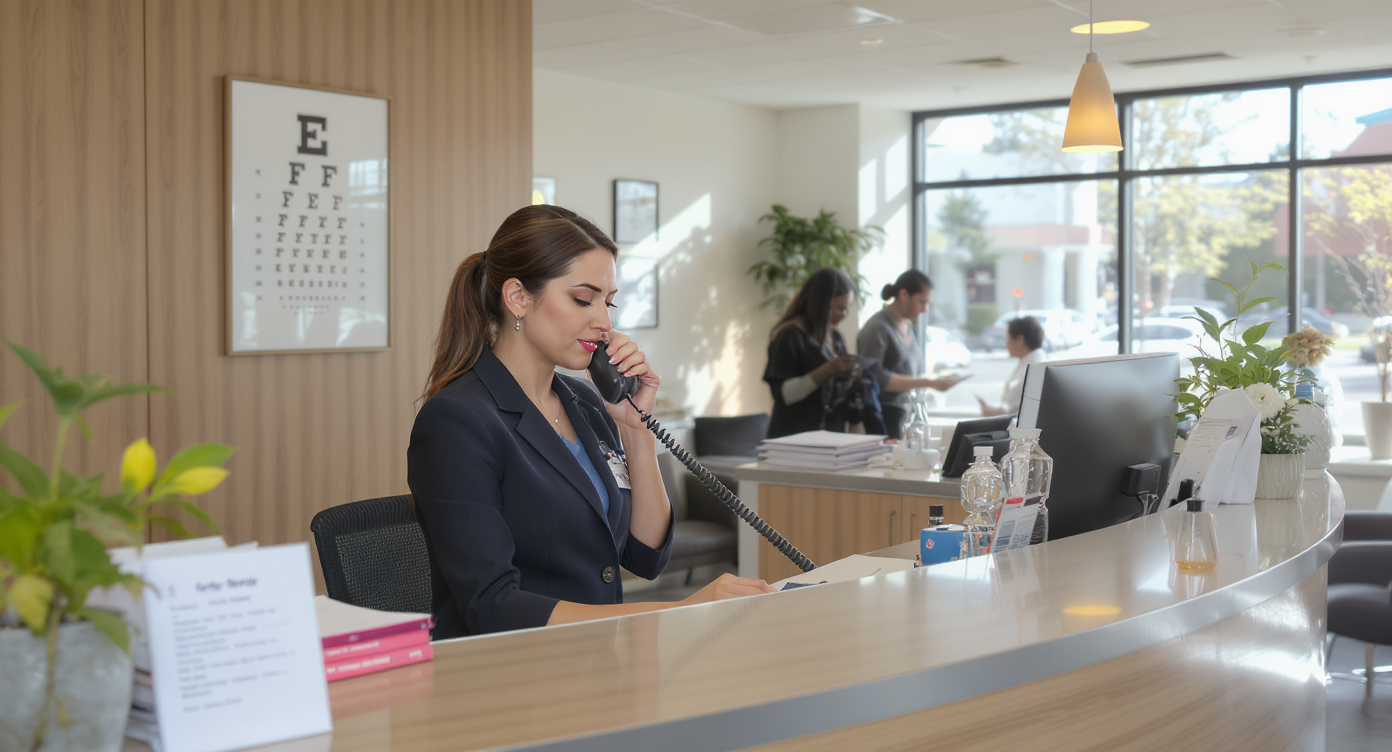
Every optometry practice loses patients it never even knows about. Someone calls to schedule an eye exam, gets voicemail, and books with the practice down the street instead. It happens constantly. Most owners don’t realize how often. Learning how to reduce missed calls for optometry practices isn’t just a phone management issue. It’s a revenue issue, a patient retention issue, and, for many clinics, the single biggest operational gap hiding in plain sight. Sound familiar?
Reducing missed calls for optometry practices means capturing every incoming appointment request before patients book elsewhere. This involves using live answering services, call routing systems, or automated callbacks to ensure no caller reaches voicemail. Even one missed call daily costs practices thousands in lost revenue annually.
Quick Answer
Optometry practices can reduce missed calls by implementing a multi-line phone system to handle simultaneous calls, hiring dedicated staff during peak hours, using call routing to distribute incoming calls efficiently, setting up voicemail with callback options, and considering automated appointment reminders via text or email to reduce no-shows that free up capacity for new patients.
What Are Missed Calls and Why Do They Matter for Optometry?
A missed call is any incoming phone call that goes unanswered by a live person or fails to connect the caller with a useful outcome. That includes calls that ring to voicemail, calls abandoned while on hold, and calls that drop during after-hours. In optometry, these calls almost always represent a patient trying to schedule an appointment, ask about insurance, or get pricing on lenses and frames.
Free weekly newsletter
Growth tips for dental & medical practices
Every Tuesday — actionable ideas to get more leads, reviews, and repeat customers. No fluff.
The financial impact is staggering. According to research on the cost of missed calls, a single unanswered call can represent hundreds of dollars in lost revenue when you factor in the exam fee, frame purchases, and lifetime patient value. Multiply that across dozens of missed calls per week, and you’re looking at tens of thousands in annual losses. Think about that for a moment. Data from Aira shows that a majority of business calls go unanswered, which means this problem isn’t limited to practices that feel understaffed. It’s everywhere.
For optometry specifically, the stakes are higher than average. Patients typically visit once or twice a year, so every touchpoint matters. If a patient can’t reach you when they’re ready to book, there’s a strong chance they won’t call back. They’ll search for another optometrist, find one that answers, and never think about your practice again.
Why Optometry Practices Miss So Many Calls
Before you can fix the problem, you need to understand where the gaps are. Most practices don’t miss calls because they’re careless. They miss calls because the volume and timing don’t match their staffing model. It’s that simple.
Peak-Hour Overload
Monday mornings and lunch hours generate a disproportionate number of inbound calls. Your front desk staff is already checking in patients, verifying insurance, and handling walk-ins. When three calls come in at once, two of them go to voicemail. That’s the reality. It’s not a staffing failure. It’s a structural one.
After-Hours and Weekend Calls
Patients don’t schedule their eye care needs around your office hours. Many people search for optometrists in the evening after work, and they expect to reach someone or at least get a useful response. A voicemail greeting that says “we’ll call you back during business hours” isn’t useful. By then, they’ve already booked elsewhere. Your window has closed.
Hold Times and Call Abandonment
Even calls that technically get answered can become missed opportunities if patients are placed on hold too long. Research from Voksha highlights how quickly callers abandon calls when put on hold. For healthcare-adjacent businesses like optometry, where patients are comparing options, every extra second on hold erodes trust. Patients just hang up.
No Backup for Front Desk Absences
When your receptionist takes a sick day, goes on vacation, or steps away for a break, who’s answering the phone? Most small practices don’t have a backup plan. The result is predictable: missed calls pile up on exactly the days you can least afford them.
📺 Watch: Missed Call Text Back Setup in 5 Minutes
Proven Strategies to Reduce Missed Calls in Your Optometry Practice
Fixing missed calls requires a combination of technology, process changes, and realistic expectations about what your team can handle. Here are the strategies that actually work. They’ve been tested across hundreds of practices.
Set Up an Automated Reminder and Recall System
A surprising number of inbound calls are patients trying to confirm, reschedule, or ask about existing appointments. According to the American Optometric Association, no-shows remain a persistent challenge for eye care providers. Automated reminders via text and email reduce these calls significantly. Your phone lines stay open. New patients get through.
- Send appointment reminders 48 hours and 24 hours before the visit via SMS
- Include a one-tap option to confirm, cancel, or reschedule directly from the text
- Automate recall messages for annual exams so patients don’t need to call to rebook
- Follow up on no-shows automatically with a rebooking link
Enable Online Booking and Self-Service Options
Every appointment that gets booked online is one fewer call your team needs to answer. Yet many optometry practices still rely on phone-only scheduling. Adding online booking to your website, Google Business Profile, and social media pages captures patients who prefer self-service. That’s most patients under 45.
Self-service doesn’t stop at booking. Providing FAQs about insurance acceptance, office hours, and new patient paperwork on your website deflects routine calls. That leaves your phone lines open for the calls that genuinely need a human touch. It’s that straightforward.
Use Missed-Call Text-Back to Recover Lost Callers
Here’s a tactic that most optometry practices overlook entirely. When a call goes unanswered, an automated text message is sent to the caller within seconds. Something like: “Hi, we’re sorry we missed your call. How can we help? You can also book online here: [link].” This simple automation recovers a significant percentage of callers who would otherwise be lost.
Why does it work? Because the patient still has your practice on their mind. They just called you. A fast text response keeps you in the conversation before they move on to a competitor. SchedulingKit’s analysis of missed call revenue loss shows just how quickly the window closes after an unanswered call. Speed is everything.
Extend Your Availability Without Extending Your Payroll
Hiring a second receptionist or extending office hours sounds great on paper, but the math rarely works for a single-location optometry practice. The better approach is using technology to handle calls outside your team’s capacity. No extra headcount needed.
- AI-powered phone agents can answer calls 24/7, book appointments, and answer common questions without human involvement
- Call routing rules ensure that during business hours, calls overflow to a backup number or virtual agent instead of voicemail
- After-hours call flows capture caller information and intent, so your team can follow up first thing in the morning with full context
These aren’t theoretical solutions. According to CloudTalk’s overview of after-hours AI receptionists, businesses using virtual agents see dramatic improvements in call capture rates. The technology has matured to the point where callers often can’t distinguish an AI agent from a trained receptionist. It’s that good now.
Audit Your Call Flow Regularly
Most practices set up their phone system once and never revisit it. That’s a mistake. Patient call patterns shift seasonally, and your call flow should adapt. Review your call data monthly to identify peak missed-call times, common reasons for calls, and bottlenecks in your current routing. Stay on top of it.
Look specifically at these metrics:
- Total calls vs. answered calls, broken down by hour of day and day of week
- Average hold time before abandonment
- Percentage of calls that reach voicemail
- Callback rate on missed calls (how many patients actually call back?)
Without this data, you’re guessing. And guessing is expensive in a business where a single patient relationship can be worth thousands of dollars over a decade.
Common Mistakes That Make Missed Calls Worse
Some well-intentioned “fixes” actually increase the problem. Here’s what to avoid.
First, don’t rely on voicemail as a safety net. Most patients won’t leave a message. They’ll hang up and call somewhere else. Voicemail is where patient leads go to die. Second, avoid complex IVR menus that force callers through multiple layers of “press 1 for…” options. Every additional menu layer increases the abandonment rate. Keep it simple. One or two options maximum, with a fast path to a live person or AI agent.
Third, don’t assume your team will “just answer the phone better.” Willpower doesn’t solve a capacity problem. If your receptionist is physically unable to answer every call because they’re also handling check-ins, no amount of training will close the gap. You need a structural solution, not a motivational one. That’s just reality.
Finally, ignoring the data is perhaps the most damaging mistake. Small business statistics from NAWBO consistently show that businesses underestimate the volume of opportunities they lose through communication gaps. If you don’t measure it, you can’t improve it.
How SalesCaptain Helps
SalesCaptain addresses every root cause of missed calls for optometry practices through a single platform. Its AI Phone Agent answers calls around the clock with natural-sounding conversation, booking appointments, answering FAQs about insurance and office hours, qualifying new patients, and blocking spam calls that waste your front desk’s time. No technical expertise required.
When a call does go unanswered, SalesCaptain’s missed-call text-back feature sends an instant SMS to the caller, keeping the conversation alive. Its AI Chat Agents extend that responsiveness across SMS, webchat, Instagram DMs, and Facebook Messenger, covering every channel your patients use. All conversations flow into a single Unified Inbox. Your team sees every patient conversation in one place, with full context and history.
The platform’s drag-and-drop Call Flow builder lets you create custom routing rules in minutes. Route calls to specific team members during business hours, overflow to the AI agent during peak times, and capture after-hours callers with intelligent call flows that record intent and schedule callbacks. Workflow Automation handles follow-ups, appointment reminders, and recall messages without manual effort. Plus, with integrations for tools like HubSpot, Zoho, and HousecallPro, SalesCaptain fits into the systems you’re already using.
Pricing starts with a free plan for a single location, with paid plans at $159/month per location. That’s a fraction of what you’d spend on additional front desk staff. And it covers 24/7 availability that no single employee can match.
Key Takeaways
Reducing missed calls for your optometry practice isn’t about working harder. It’s about removing the structural gaps that cause calls to slip through. Automated reminders reduce inbound call volume. Online booking gives patients a self-service path. Missed-call text-back recovers callers who didn’t get through. And AI phone agents extend your availability to 24/7 without extending your payroll.
The practices that thrive aren’t necessarily the ones with the best clinical care, though that matters too. They’re the ones that answer when a patient calls. Every unanswered ring is revenue walking out the door. Fix the phone, and you’ll fix a problem most practice owners don’t even realize they have.
Frequently Asked Questions
How many calls does a typical optometry practice miss per week?
While it varies by practice size and staffing, most small healthcare practices miss between 20% and 40% of inbound calls. During peak hours, lunch breaks, and after-hours periods, that percentage climbs significantly. Track your own call data for even one week. You’ll probably be surprised.
Will patients actually respond to a missed-call text-back?
Yes. Response rates on missed-call text-backs are considerably higher than voicemail callback rates. Because the text arrives within seconds of the missed call, the patient is still in “booking mode” and more likely to engage. Many patients actually prefer texting over phone calls. It’s less intrusive.
Can an AI phone agent handle insurance-related questions?
AI phone agents like SalesCaptain’s can be trained on your specific insurance information, office policies, and common patient questions. They won’t process insurance claims, but they can tell callers which plans you accept, what to bring to their first visit, and how to verify coverage before their appointment. It handles the routine stuff.
Is an AI phone agent appropriate for a healthcare-adjacent business like optometry?
Absolutely. Optometry practices handle a high volume of routine scheduling and FAQ calls that don’t require clinical judgment. An AI agent handles those efficiently while routing complex clinical questions to your staff. Patients get faster answers. Your team focuses on in-office care. Everyone wins.
What’s the fastest way to start reducing missed calls today?
The highest-impact, lowest-effort first step is enabling missed-call text-back. It requires no changes to your existing workflow and immediately captures callers who would otherwise be lost. From there, adding online booking and an AI phone agent creates a comprehensive solution. That covers every gap.
Ready to see it in action?
See how optometry practices use SalesCaptain to capture every missed call and book more patients.
Book a Free Demo →See How SalesCaptain Can Help Your Optometry Practice
Stop losing patients to unanswered calls. SalesCaptain’s AI Phone Agent, missed-call text-back, and unified inbox give your practice 24/7 coverage without adding staff. Start with a free plan and see the difference in your first week.