
AI-powered customer experience marketing (CXM) platform that helps local businesses win.


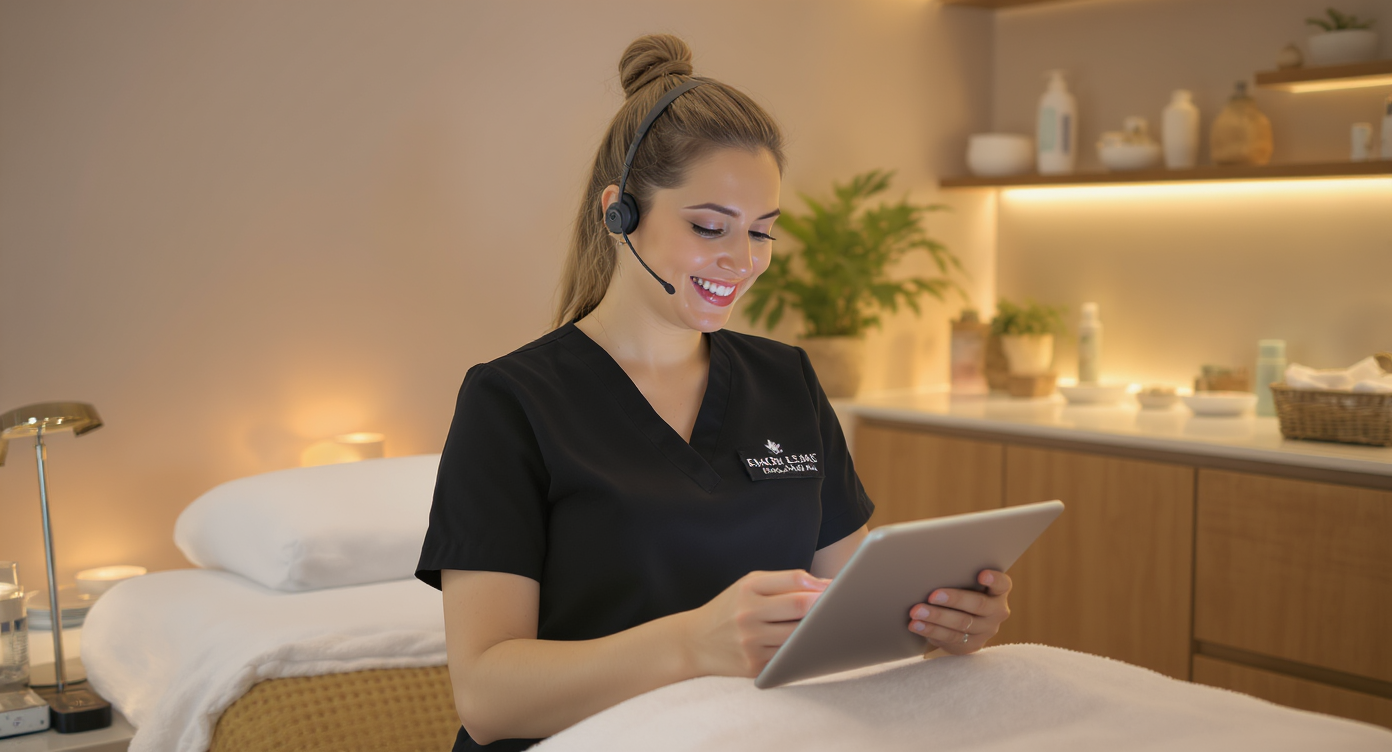
You’re with a client mid-facial, your hands are gloved, and the phone rings. Then it rings again. By the time you check, you’ve got two missed calls and zero voicemails. One of those callers just booked with your competitor down the street. Sound familiar? Finding the best phone system for estheticians isn’t about getting the fanciest technology. It’s about making sure every potential client reaches you, even when you can’t pick up.
The best phone system for estheticians is a communication platform that captures calls, texts, and messages across multiple channels—even when you’re with clients. It handles appointment booking, service inquiries, and follow-ups automatically, ensuring no potential client reaches your competitor because you couldn’t answer.
What Is an Esthetics-Focused Phone System?
A phone system for estheticians goes beyond basic calling. It’s a communication platform designed to handle the specific workflow of an appointment-driven beauty business: booking consultations, answering questions about services and pricing, sending reminders, and following up after treatments. Today’s clients might call, text, DM on Instagram, or message through your website. So your system needs to work across all those channels.
For solo practitioners and small esthetics teams, the phone system essentially acts as a front desk. It needs to capture every inquiry. Respond quickly. Keep your schedule full. That’s a tall order when you’re elbow-deep in extractions. According to research from Aira, a significant percentage of business calls go unanswered, which translates directly into lost revenue for service businesses like yours.
Why Generic Phone Systems Fall Short for Esthetics Practices
The Solo Practitioner Problem
Most estheticians operate as solo practitioners or in very small teams. You don’t have a receptionist. You can’t pause a chemical peel to answer the phone. And yet, your business depends entirely on incoming inquiries converting into booked appointments. Generic VoIP systems assume someone is always available to answer. That assumption doesn’t match your reality.
Traditional phone solutions like Grasshopper or basic landline forwarding give you a number and maybe voicemail. But voicemail is a dead end. Most people won’t leave messages. Data from UseGreet shows that the true cost of missed calls for small businesses is substantial, factoring in the lifetime value of each lost client. For an esthetician charging $100-200 per facial, losing even a few clients per month adds up fast.
Per-User Pricing Traps
Many phone platforms charge per user or per seat. Aircall, for example, starts at $30 per license per month. OpenPhone runs $15 per user. Those numbers seem reasonable until you realize you’re paying for features built for sales teams, not service providers. Call flip and Chrome extensions are nice for desk-bound salespeople. But they don’t solve your core problem: being physically unavailable during appointments.
What’s worse, per-user pricing punishes you for growing. Add a second esthetician or a part-time receptionist, and your costs jump. That gets expensive fast. SalesCaptain’s per-location pricing model avoids this entirely, so your team can grow without your phone bill scaling alongside it.
Key Features to Evaluate in an Esthetics Phone System
Not every feature matters equally for your practice. Here’s what actually moves the needle:
- After-hours call capture: Your clients often search for services and call during evenings and weekends. If your system can’t handle those calls intelligently, you’re losing bookings during your highest-intent windows.
- Missed call text-back: When a call goes unanswered, an automatic text response keeps the conversation alive. The client gets an immediate acknowledgment, and you can reply between appointments.
- Appointment booking integration: The phone system should connect to your scheduling tool so appointments can be booked without manual back-and-forth.
- Multichannel messaging: Clients reach out via Instagram DMs, website chat, text, and phone. Juggling five different apps is chaotic and guarantees dropped conversations.
- Automated reminders: No-shows are expensive. Automated SMS reminders reduce them significantly without requiring you to manually text each client.
- Spam blocking: Estheticians report getting flooded with robocalls and vendor spam. A good system filters those out so you only deal with real inquiries.
Platforms like Birdeye and Podium cover some of these bases but miss critical pieces. Birdeye, for instance, lacks call routing, IVR, and any AI for calls. It’s primarily a reputation management tool. Podium doesn’t offer outbound workflow automation or transparent pricing. Neither provides the full communication stack an esthetics practice actually needs.
How AI Changes the Game for Estheticians
Here’s where the conversation shifts. What if you didn’t need someone answering the phone at all? AI voice agents can now handle natural-sounding conversations, answer frequently asked questions about your services, and book appointments directly into your calendar. This isn’t a clunky phone tree. It’s actual conversation.
Think about the calls your practice gets most often. “How much is a HydraFacial?” “Do you take walk-ins?” “What’s your availability this Saturday?” These questions repeat constantly. An AI agent handles them perfectly every single time, 24 hours a day. You stay focused on the client in your chair.
Hiring a human receptionist costs around $30,000-$36,000 per year according to the Bureau of Labor Statistics. Virtual receptionist services like Smith.ai or Ruby charge premium per-minute rates that escalate quickly. TechnologyAdvice’s analysis of AI answering services shows that AI alternatives now deliver comparable quality at a fraction of the cost. That’s meaningful for solo estheticians watching every dollar.
What About Clients Who Prefer Texting?
Most of your younger clients won’t call at all. They’ll text, DM, or use webchat. A phone system that only handles voice calls leaves half your audience unserved. Multichannel isn’t a luxury anymore. According to Zoom’s VoIP statistics report, businesses using unified communication platforms see measurably better engagement compared to those relying on voice-only systems.
Your system should let you manage Instagram DMs, Facebook Messenger, SMS, webchat, and calls from one place. Otherwise, you’ll spend your breaks switching between apps trying to piece together who said what and where.
Comparing Popular Options for Esthetics Practices
Let’s look at how some commonly considered platforms stack up for an esthetics-specific use case:
| Feature | SalesCaptain | OpenPhone | Nextiva | Weave |
|---|---|---|---|---|
| Missed Call Text-Back | Yes | No | No | Yes |
| Social Media DMs (Instagram, FB) | Yes | No | No | No |
| Unified Inbox | Yes | Limited | Limited | Limited |
| Payments via Text | Yes | No | No | No |
| Appointment Booking AI | Yes | No | No | No |
| Pricing Model | Per location (free plan available) | $15/user | $20/user | Not public |
Weave is popular in healthcare and dental niches, but it lacks social chat, WhatsApp, and advanced AI automation. It’s not designed for the broader esthetics and beauty vertical. OpenPhone is affordable but minimal. It rated only 1 out of 5 for AI capabilities, has just 7 integrations, and offers no call coaching or power dialer. For a practice that needs automation, it falls short.
Nextiva caps SMS at 250 messages per user per month. That’s a problem if you’re sending appointment reminders and follow-ups to a full client roster. It also lacks leads forms and payments via text. Both help estheticians collect deposits and reduce no-shows. Verified Market Research reports that the U.S. business phone system market continues to grow, driven in part by small businesses demanding more integrated, AI-capable platforms.
How SalesCaptain Helps
SalesCaptain combines everything an esthetics practice needs into a single platform. The AI Phone Agent answers calls around the clock with natural-sounding conversation. It books appointments, answers pricing questions, and blocks spam. Between appointments, you check your Unified Inbox to see every call, text, Instagram DM, and webchat message in one view.
For estheticians specifically, a few features stand out:
- AI Chat Agents respond instantly on SMS, webchat, Instagram, and Facebook Messenger, capturing leads even when you’re unavailable.
- Workflow Automation handles follow-up sequences, appointment reminders, and CRM updates without manual effort. The drag-and-drop builder doesn’t require any technical skills.
- AI Summaries and Transcriptions give you a quick overview of every call, so you can review client concerns and follow up with personalized care recommendations.
- Payments via Text let you collect deposits before appointments, cutting down on no-shows.
- Call Flows with the visual builder ensure every incoming call follows a consistent path, whether it’s routing to you, playing a greeting, or handing off to the AI agent.
The free Startup plan covers one location. Solo estheticians can start without any monthly cost. Growing practices pay $159/month per location on the Business plan. AI calls are billed at $0.12/minute. That’s a fraction of what a part-time receptionist or virtual answering service would cost. Plus, with 50+ integrations including HousecallPro, Mindbody, and Zapier, it connects to the tools you’re already using.
Key Takeaways
The best phone system for estheticians isn’t the one with the most features on paper. It’s the one that captures every client inquiry, responds immediately, and books appointments without pulling you away from your work. Generic VoIP systems assume someone’s always free to answer. Per-user pricing penalizes small teams for growing. Voice-only platforms ignore the channels your clients prefer.
AI-powered communication platforms have changed what’s possible for solo and small-team estheticians. You can deliver the responsiveness of a fully-staffed front desk without the overhead. Every missed call becomes a text-back. Every DM becomes a booked appointment. Research from oVox confirms that missed calls remain one of the largest hidden revenue leaks for small businesses. Solving this problem isn’t optional. Choose a system built for how your practice actually operates, and you’ll stop losing clients to competitors who simply picked up faster.
Frequently Asked Questions
What’s the biggest phone system mistake estheticians make?
Relying on a personal cell phone or basic voicemail. Most clients won’t leave messages. They’ll call the next esthetician on their search results instead. A dedicated business phone system with missed call text-back and after-hours AI answering solves this immediately.
Do I need a separate phone number for my esthetics business?
Yes. A dedicated business number looks more professional. It keeps your personal life separate. And it lets you use features like call routing, IVR menus, and automated texting. SalesCaptain provides business phone numbers with its plans. You don’t need a separate provider.
How much should an esthetician expect to pay for a phone system?
Entry-level VoIP systems run $15-30 per user per month. Platforms with AI agents and automation typically cost $100-300 per month. SalesCaptain offers a free plan for single locations. Paid plans start at $159/month per location regardless of team size.
Can an AI phone agent really book appointments for estheticians?
Absolutely. Modern AI voice agents carry on natural conversations. They ask qualifying questions, check calendar availability, and confirm bookings. They handle routine calls like scheduling, pricing inquiries, and hours of operation without any human involvement.
What if I have multiple esthetics locations?
Per-location pricing models work best for multi-location practices. Your cost stays predictable as you add staff. Each location gets its own phone number, call flows, and AI agent configuration. Per-user pricing from platforms like OpenPhone or Aircall becomes expensive quickly when you’re staffing multiple locations.
See How SalesCaptain Can Help Your Esthetics Practice
SalesCaptain gives estheticians the AI-powered phone system, multichannel messaging, and automation tools to capture every lead and book more appointments. No need to hire additional staff. Start with the free plan and see the difference a 24/7 AI agent makes for your practice. Visit SalesCaptain to get started today.