
AI-powered customer experience marketing (CXM) platform that helps local businesses win.


Customer Communication Platform for HVAC Companies: Stop Losing Jobs to missed calls and Slow Responses
Every HVAC company knows the pain. Your technicians are knee-deep in a furnace replacement, your office phone is ringing off the hook, and by the time someone calls back, the homeowner already booked with your competitor. A customer communication platform for HVAC companies solves this problem by making sure every call, text, and message gets answered instantly, even when your entire crew is in the field. For an industry where emergency calls can come at 2 AM and a single missed estimate request can cost thousands, having the right communication system isn’t optional anymore. It’s literally the difference between growing your business and watching revenue walk out the door.
HVAC is a business built on trust and responsiveness. Homeowners with a broken AC in July or a dead furnace in January aren’t browsing, they’re calling the first three companies they find and going with whoever answers. Sound familiar? If that’s not you, it doesn’t matter how skilled your technicians are or how competitive your pricing is, the job goes to the company that picks up the phone. This guide breaks down exactly why communication is the bottleneck for most HVAC businesses and how SalesCaptain’s AI-powered platform eliminates it, without requiring you to hire more office staff.
Why HVAC Businesses Struggle With Customer Communication
The HVAC industry has a unique communication problem that most other service businesses don’t face at the same scale. Your busiest call volume happens during your busiest service periods, extreme heat waves and cold snaps drive both emergency calls and routine maintenance requests simultaneously. When demand spikes, your team is stretched thin on the service side, which means the phones go unanswered at the exact moment more customers are trying to reach you. As FieldBoss reports, poor communication, not high prices, is the real problem plaguing the HVAC industry. Customers don’t leave because your quote was too high. They leave because they couldn’t get ahold of anyone.
Free weekly newsletter
Growth tips for home service businesses
Every Tuesday — actionable ideas to get more leads, reviews, and repeat customers. No fluff.
The After-Hours Emergency Gap
HVAC emergencies don’t respect business hours. A family’s heat pump fails at 10 PM on a Saturday, and they need someone now. Most HVAC companies either route after-hours calls to a generic voicemail or pay for expensive answering services that can’t actually book appointments or answer technical questions. Here’s the hard truth: According to industry phone statistics compiled by AgentZap, a significant percentage of HVAC calls go unanswered, and most of those callers never call back. They simply move on to the next company. That’s revenue disappearing every single night and weekend, compounding into tens of thousands of dollars in lost jobs over a year.
Slow Estimate Follow-Up Kills Close Rates
Getting the initial call is only half the battle. After your technician provides an estimate for a new system install or major repair, the follow-up process often falls apart. Technicians are busy on the next job. Office staff get buried in scheduling. And that $8,000 estimate sits in a homeowner’s inbox without a single follow-up for days. Research from Hatch on HVAC estimate follow-up response rates shows that speed and persistence in following up on estimates directly impacts close rates. The companies that follow up within minutes, not hours or days, close dramatically more jobs from the same lead volume. Yet most HVAC businesses lack a systematic way to do this without adding headcount.
Too Many Channels, No Central System
Today’s HVAC customers don’t just call. They text, fill out website forms, send Facebook messages, leave Google Business Profile inquiries, and reply to email campaigns. What does that actually look like? For a typical HVAC company with one or two office staff, managing all these channels separately is a recipe for dropped leads and duplicated effort. One person checks voicemail, another monitors the website chat, and nobody is watching Instagram DMs, where a growing number of homeowners are reaching out after seeing project photos. Without a unified system, messages fall through the cracks, and your team wastes time switching between five different apps trying to piece together a customer’s conversation history.
How SalesCaptain Solves This for HVAC Companies
SalesCaptain is a customer communication platform for HVAC companies that combines AI voice agents, AI chat agents, and a unified inbox into one system built specifically for service businesses. Instead of hiring an additional receptionist or paying for a call center that reads from a generic script, you deploy AI agents that know your business, your service area, your pricing structure, your scheduling availability, and they handle customer interactions 24/7 without human intervention. Here’s how each piece works for an HVAC operation.
AI Phone Agent: Your 24/7 HVAC Receptionist
SalesCaptain’s AI Phone Agent answers every incoming call with a natural-sounding voice that doesn’t feel robotic or frustrating to callers. When a homeowner calls about a broken furnace at midnight, the AI agent can ask qualifying questions (What type of system? How old is it? Is there an immediate safety concern?), book an appointment for the next available slot, and send the customer a confirmation text, all without waking up anyone on your team. During business hours, it handles overflow calls when your office staff is already on the line, so no call goes to voicemail during peak periods.
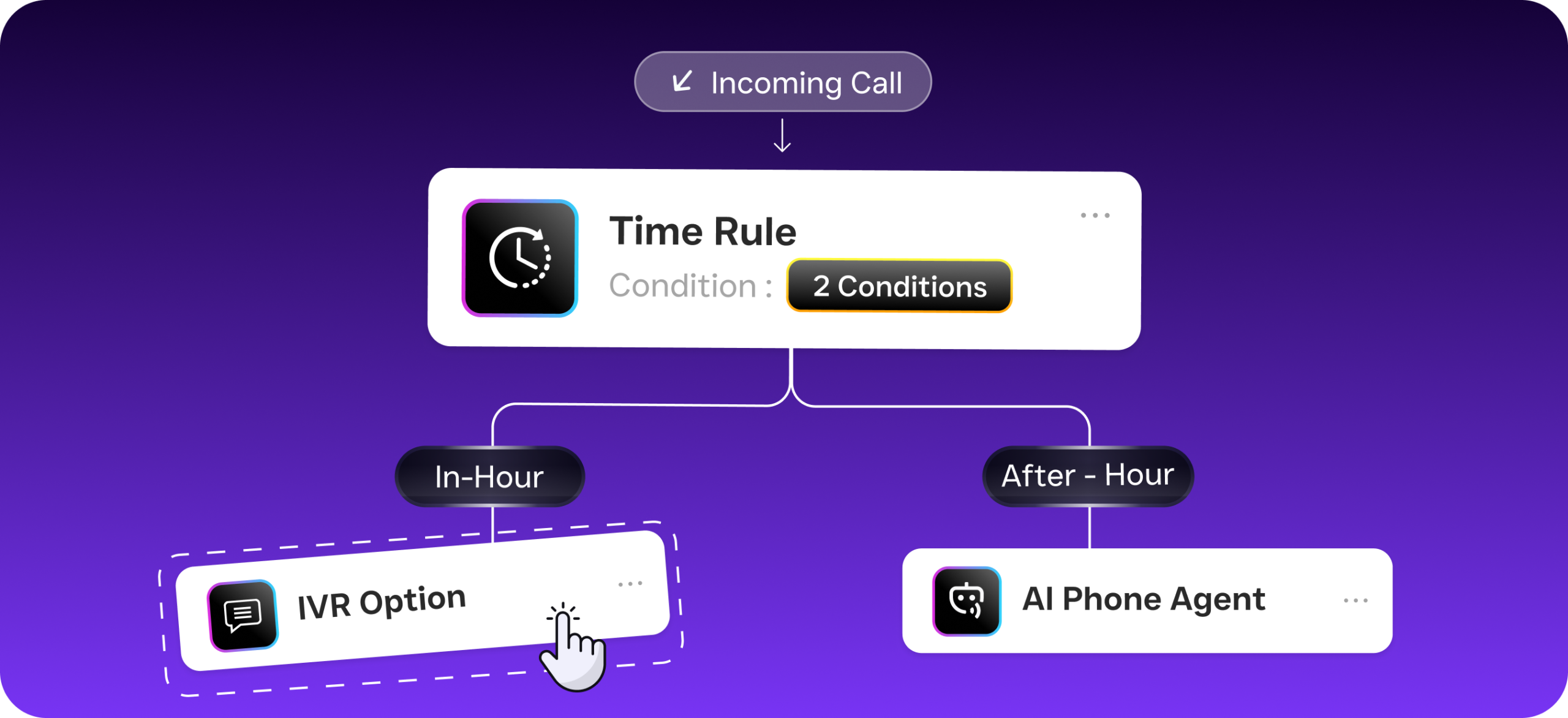
The agent also blocks spam calls. That’s a bigger drain on HVAC office productivity than most owners realize. Between warranty scam robocalls, supplier solicitations, and SEO companies promising to get you ranked number one, your staff can waste significant time each day screening junk calls. The AI Phone Agent filters those out automatically and only routes real customer calls and urgent matters to your team. You can customize the call flows to handle different scenarios, routing emergency calls differently from routine maintenance requests, for example, or qualifying whether a caller is a homeowner or a property manager with multiple units.
AI Chat Agents: Instant Response on Every Channel
SalesCaptain’s AI Chat Agents work across SMS, your website’s live chat, Instagram DMs, and Facebook Messenger, all from the same platform. When someone texts your business number asking for a quote on a new AC installation, the AI responds instantly with qualifying questions and can book a site visit without human involvement. The same agent handles your website visitors who are comparing HVAC companies at 11 PM, capturing their information and scheduling an estimate before they click over to your competitor’s site.
One feature that’s particularly valuable for HVAC companies is missed call text-back. When a call does go unanswered, maybe your AI agent is handling a complex call and a second one comes in, SalesCaptain automatically sends a text message to the caller within seconds. That text can say something like, “Thanks for calling [Your Company Name]. We’re helping another customer right now, can we help you via text, or would you like us to call you back?” This keeps the customer engaged instead of hanging up and dialing the next company. For HVAC businesses that rely on appointment reminders to reduce no-shows, the AI chat agent also handles automated reminders via text, cutting down on wasted truck rolls.
Unified Inbox: One Place for Every Conversation
SalesCaptain’s Unified Inbox pulls every customer interaction, phone calls, texts, webchat conversations, social media DMs, and email, into a single, collaborative inbox. Your office manager can see the full history of a customer’s interactions in one thread: the initial call the AI agent handled Tuesday night, the follow-up text exchange Wednesday morning, and the appointment confirmation sent that afternoon. No switching between apps. No asking, “Did anyone follow up with the Johnson job?” Every interaction is logged and visible to the whole team in real time.
For HVAC companies with multiple locations, this is especially powerful. Each location can have its own phone number and communication workflows, but managers or owners can monitor all locations from a single dashboard. Effective communication strategies for HVAC businesses emphasize the importance of consistency across every customer touchpoint, and a unified inbox is what makes that consistency possible at scale. You don’t need more staff. You need better systems.
Key Features for HVAC Businesses
SalesCaptain was built for service businesses, and HVAC companies are one of its core use cases. Every feature below addresses a specific pain point that HVAC owners deal with daily. Here’s what matters most for your operation:
24/7 Call Answering with AI: Never miss an emergency call or a new customer inquiry, day, night, weekends, or holidays. The AI Phone Agent handles calls when your office is closed and during overflow periods when staff is tied up. Automated Appointment Booking: The AI agent checks your real-time availability and books service calls or estimate appointments directly into your calendar. No back-and-forth phone tag required. Lead Qualification on Every Call: Before booking an appointment or routing to a technician, the AI asks the right questions, system type, age, issue description, service address, so your team shows up prepared. Missed Call Text-Back: Any call that goes unanswered triggers an immediate text response, keeping the lead warm instead of losing them to a competitor. Multichannel Messaging: Manage SMS, webchat, Instagram, and Facebook messages from one inbox. Respond instantly to customers on whichever channel they prefer. Workflow Automation: Build drag-and-drop workflows for estimate follow-ups, maintenance reminders, seasonal tune-up campaigns, and post-service review requests. Set them once and let them run. Spam Call Blocking: Automatically filter out robocalls and solicitations so your team only spends time on real customers. Integrations with HVAC Software: SalesCaptain connects with HousecallPro, ServiceFusion, QuickBooks, Zapier, and 50+ other tools, so it fits into the systems you already use without ripping anything out. and Business Phone System: Full phone system with 99.99% uptime, call recording, IVR menus, call routing, and voicemail, replacing or supplementing your existing phone setup..
How SalesCaptain Compares to Other HVAC Communication Tools
HVAC companies have options when it comes to communication software, but most tools only solve part of the problem. Some handle texting but can’t touch phone calls. Others focus on reputation management but don’t offer AI-powered automation. SalesCaptain is the only platform that combines AI voice agents, AI chat agents, and a unified inbox in a single tool, purpose-built for service businesses. Here’s how it stacks up against the alternatives HVAC companies commonly evaluate:
| Feature | SalesCaptain | Podium | Weave | HighLevel | Kenect |
|---|---|---|---|---|---|
| AI Phone Agent (Voice) | ✅ | ❌ | ❌ | ❌ | ❌ |
| AI Chat Agents (SMS, Web, Social) | ✅ | Limited | Limited | ✅ (complex setup) | SMS only |
| Unified Inbox (All Channels) | ✅ | ✅ | ✅ | ✅ | ❌ |
| Outbound Automation | ✅ | ❌ | Limited | ✅ | Limited |
| Built for Service SMBs | ✅ | Partial | Medical/Dental focus | ❌ (Agency focus) | Partial |
| Free Plan Available | ✅ | ❌ | ❌ | ❌ | ❌ |
| Ease of Setup | 10 minutes | Moderate | Moderate | Steep learning curve | Easy |
| HVAC Software Integrations | HousecallPro, ServiceFusion, 50+ | Limited | Limited | Via Zapier | Limited |
As the 2025 HVAC industry trends from HousecallPro make clear, automation and AI adoption are accelerating across the trades. The companies investing in these tools now are building competitive advantages that’ll compound over time. Choosing a platform that only solves texting or only manages reviews means you’ll be shopping for another tool in six months when you realize you still need voice AI and workflow automation.
Real Results You Can Expect
Switching to a customer communication platform for HVAC companies like SalesCaptain doesn’t just feel better. It directly impacts your bottom line. Here are the outcomes HVAC businesses can realistically expect when every call, text, and message is handled instantly and automatically.
Capture Revenue You’re Currently Losing
The most immediate impact is capturing the calls and messages you’re currently missing. If your HVAC company misses even a handful of calls per week, and industry data suggests most companies miss far more than they realize, each one represents a potential job worth hundreds or thousands of dollars. Emergency calls are especially high-value: a homeowner whose heat dies in January will pay premium rates for same-day service. When your AI Phone Agent answers that call at 11 PM, qualifies the issue, and books a morning appointment, you’ve captured revenue that would’ve gone to a competitor with a live answering service or a luckier timing on their voicemail. Over a year, the recovered revenue from previously missed calls alone can be substantial, many times the cost of the platform.
Close More Estimates Without Hiring Sales Staff
Automated estimate follow-up is where SalesCaptain’s workflow automation really shines for HVAC businesses. After a technician provides a quote for a system replacement or major repair, SalesCaptain can automatically trigger a follow-up text the next day, a second follow-
Ready to see it in action?
See how HVAC companies use SalesCaptain to never miss a customer call again.
Book a Free Demo →Frequently Asked Questions
What is a customer communication platform for HVAC companies?
A customer communication platform for HVAC companies is a system that ensures every call, text, and message gets answered instantly, even when your technicians are in the field. It eliminates missed calls and slow responses that typically cause customers to book with competitors instead.
Why do HVAC companies lose jobs due to poor communication?
HVAC emergencies spike during extreme weather events when your team is already stretched thin on service calls, causing phones to go unanswered at peak demand times. Homeowners with urgent AC or furnace problems call the first three companies they find and book with whoever answers first, meaning communication speed directly determines who wins the job.
How does a communication platform handle after-hours emergency calls?
Instead of routing calls to generic voicemail or expensive answering services, an AI-powered communication platform can handle after-hours calls automatically, answer technical questions, and book appointments without requiring staff to be in the office. This ensures that customers calling at 2 AM on weekends get immediate responses rather than voicemail.
Does using a customer communication platform require hiring more office staff?
No, an AI-powered communication platform like SalesCaptain eliminates the need to hire additional office staff by automating call answering, message responses, and appointment booking. This allows you to handle increased call volume without expanding your administrative team.
What’s the main reason HVAC customers switch to competitors?
According to the article, customers don’t leave HVAC companies because of high prices—they leave because they can’t get ahold of anyone. Poor communication and slow response times are the real problem plaguing the HVAC industry, not pricing or service quality.