
AI-powered customer experience marketing (CXM) platform that helps local businesses win.


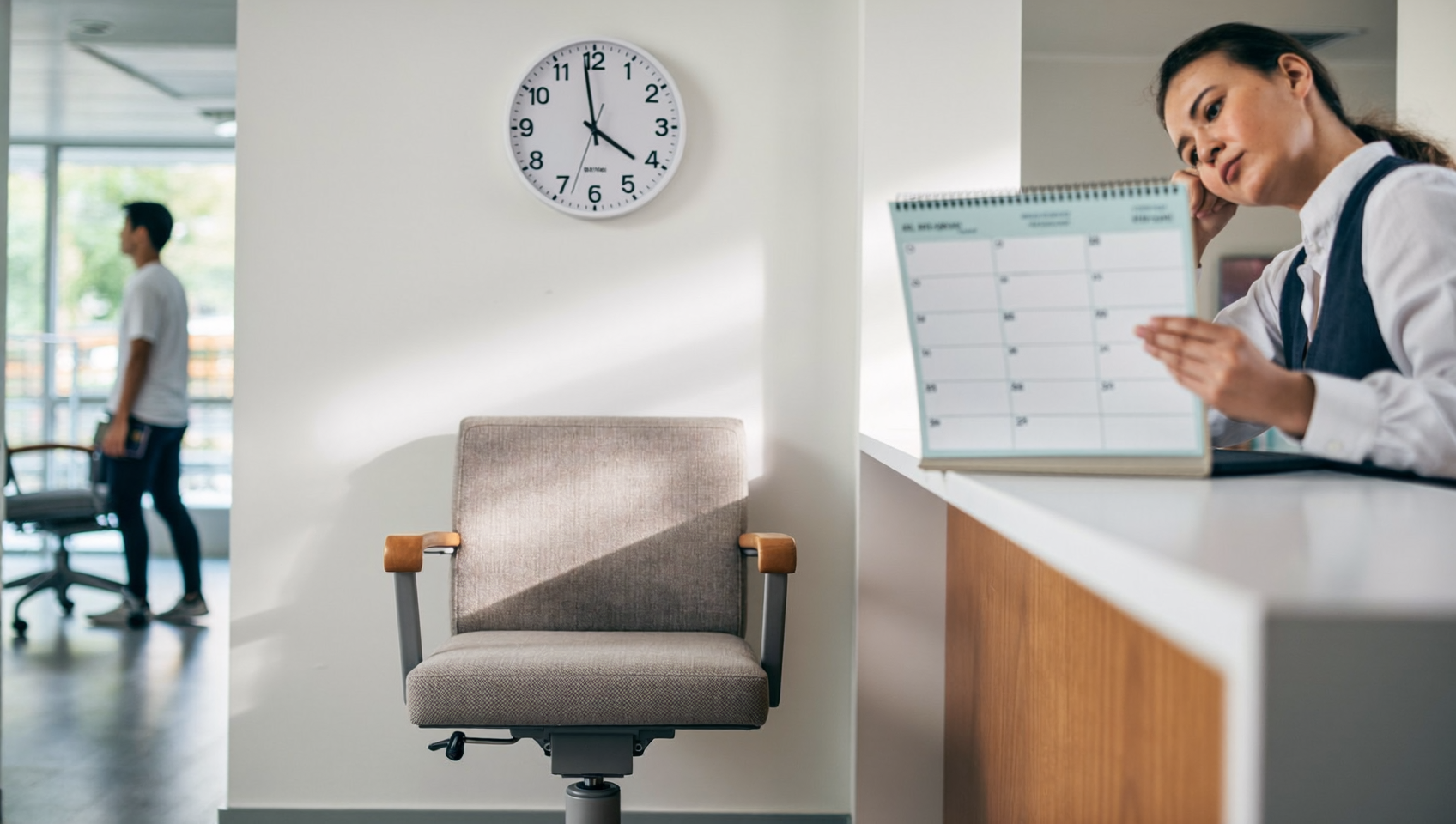
A patient books a Tuesday morning slot. The provider blocks that time, prepares the room, and waits. Nobody shows up. That empty chair isn’t just annoying. It costs real money—lost revenue, wasted staff time, and a slot that could’ve helped someone who actually needed it. No show appointment statistics reveal just how widespread this problem is across healthcare, beauty, home services, and basically every appointment-based business. Sound familiar?
No show appointment statistics measure how often customers fail to arrive for scheduled appointments without canceling. These metrics reveal costly patterns across healthcare, salons, and service businesses—lost revenue, wasted staff time, and blocked availability. Understanding no show rates helps providers implement prevention strategies and reduce financial impact.
Free weekly newsletter
Growth tips for service businesses
Every Tuesday — actionable ideas to get more leads, reviews, and repeat customers. No fluff.
Quick Answer
No-show rates typically range from 15-30% across healthcare and service industries, with dental practices averaging around 20% and medical offices closer to 25%. These missed appointments cost businesses billions annually in lost revenue and wasted staff capacity. Primary causes include forgetfulness, transportation issues, and schedule changes, though automated reminders and confirmation systems can reduce no-shows by up to 40%.
What Are No Show Appointments?
A no show happens when a customer, patient, or client books an appointment and then doesn’t show up without canceling or rescheduling. It’s different from a last-minute cancellation because there’s zero notice. The provider can’t fill the slot. The time’s just gone.
No shows aren’t limited to one industry. They plague medical practices, dental offices, salons, law firms, home service contractors, and fitness studios. While the reasons vary—forgetfulness, transportation issues, scheduling conflicts—the financial damage is consistent and brutal. Understanding no show appointment statistics helps you quantify the problem, benchmark your own rates, and build targeted strategies to reduce them.
How Much Do No Shows Actually Cost?
The financial toll is staggering. According to data from inTandem by vcita, US small businesses lost over $27 billion in unearned income in just the first half of 2023 due to client no shows. That’s everything from missed haircuts to skipped consultations. And it’s only six months.
Healthcare carries some of the heaviest losses. The Medical Group Management Association (MGMA) reports that patient no shows remain a persistent issue despite more practices adopting automated reminders. Individual practices can lose hundreds of thousands of dollars every year depending on their specialty and patient volume. On the beauty side, Professional Beauty reported that no shows cost UK beauty businesses £2.6 million in a single summer.
The Hidden Costs Beyond Revenue
Revenue loss is just the tip. Every no show creates secondary costs most business owners don’t even track:
- Staff idle time: Your team is still on the clock, whether or not the client shows up. Salaried staff cost the same regardless of patient volume.
- Opportunity cost: That slot could’ve gone to a waitlisted patient, a walk-in, or a new lead. Once it’s gone, you can’t recover it.
- Supply waste: In medical, dental, and beauty settings, consumables are often prepped before the appointment. Those materials go to waste.
- Scheduling bottlenecks: Ironically, practices with high no show rates often also have long wait times for new appointments. The two problems feed each other.
- Provider burnout: Unpredictable schedules and wasted prep time erode morale over time, particularly for smaller teams.
These compounding effects make no shows far more expensive than a simple “missed appointment fee” can offset. That’s why reducing your rate even by a few percentage points produces outsized returns.
📺 Watch: How to Set Up Appointment Reminders with Automation
Why Patients and Clients Don’t Show Up
Before you can fix the problem, you need to understand what drives it. Research from multiple industries points to consistent causes. What does that look like in practice? Let’s break it down.
Forgetfulness Is the Top Culprit
Most no shows aren’t intentional. People simply forget. Life gets busy, calendars get crowded, and an appointment booked two weeks ago slips your mind. This is especially true when the booking confirmation was just verbal or buried in a single email.
Scheduling Friction and Long Wait Times
The longer the gap between booking and the actual appointment, the higher no show rates climb. A patient who books a dermatology follow-up six weeks out is far more likely to forget than someone scheduled for tomorrow. And practices with a reputation for long wait times see higher rates because patients devalue the appointment itself.
Financial and Logistical Barriers
Cost anxiety plays a bigger role than many providers realize. A patient books before fully understanding their insurance coverage or out-of-pocket costs. By appointment day, they’ve decided they can’t afford it but feel awkward calling to cancel. Transportation issues, childcare gaps, and work conflicts create similar barriers. The Wall Street Journal has covered how businesses are increasingly charging no show fees, but fees alone don’t address root causes.
Poor Communication Channels
Here’s something you can actually control. When the only way to cancel is by calling during business hours, most people won’t bother. They might try once, get put on hold, and give up. Others feel awkward and avoid the conversation entirely. Businesses that offer text, chat, and online rescheduling options consistently see lower no show rates than those relying on phone only.
Proven Strategies to Reduce No Show Rates
Reducing no shows doesn’t require a complete overhaul. The most effective approaches combine better communication with smarter scheduling. Here’s what actually works.
Multi-Touch Automated Reminders
A single reminder isn’t enough. The best reminder sequences use multiple channels and multiple touchpoints. Send a confirmation at booking, a reminder 48 hours before, and a final reminder the morning of the appointment. Each one should include a simple way to confirm, cancel, or reschedule with just a tap or reply.
Text messages crush email for appointment reminders. SMS open rates are way higher than email, and the response barrier is lower. Yet many businesses still rely exclusively on email reminders or manual phone calls from front desk staff.
Make Canceling and Rescheduling Easy
This sounds counterintuitive, but making it simple to cancel actually reduces no shows. Here’s why: a cancellation gives you the slot back. A no show doesn’t. When patients can reply “R” to reschedule or tap a link to pick a new time, they’re more likely to take action instead of silently disappearing. Friction in the cancellation process is one of the most overlooked drivers of no shows.
Implement Waitlists and Overbooking Policies
Practices with solid no show data can use that information strategically. If your historical rate hovers around 15%, a controlled overbooking policy lets you schedule slightly above capacity. You’ll know a predictable percentage won’t arrive. Waitlists serve a similar purpose by giving you ready backfills when cancellations come in. Both strategies require good data and communication tools to avoid chaos.
Offer Flexible Scheduling and Virtual Options
For healthcare and professional services, telehealth or virtual consultations can dramatically lower no shows. A patient who can’t drive to your office might still join a video call. Similarly, offering early morning, evening, or weekend slots captures clients with traditional business hour conflicts. Remove every access barrier. Watch your rate drop.
Consider Deposit or Prepayment Models
Financial commitment changes behavior. Salons, MedSpas, and home service providers have found real success requiring a deposit at booking. The deposit doesn’t need to be large. Even a modest amount creates psychological accountability. Harvard Business Review has published extensively on how prepayment increases follow-through across consumer behavior contexts.
How SalesCaptain Helps
Reducing no shows comes down to timely, multi-channel communication. That’s where SalesCaptain fits. Instead of your front desk manually calling every patient the day before, SalesCaptain’s workflow automation builds drag-and-drop reminder sequences that fire automatically via SMS, webchat, or phone.
The AI Chat Agents handle inbound rescheduling requests 24/7. So when a client wants to reschedule at 10 PM, they don’t wait until morning. They text back, and the AI agent handles the change instantly. That’s one fewer no show.
For practices that also lose revenue to missed calls, SalesCaptain’s AI Phone Agent answers every ring. Missed call text-back ensures that even if a patient calls and hangs up, they immediately get an SMS to continue the conversation. SalesCaptain’s unified inbox ties everything together, giving your team a single view of every patient or client interaction across calls, texts, webchat, and social media DMs.
Native integrations with tools like DrChrono for healthcare, Acuity Scheduling for appointment-heavy businesses, and Housecall Pro for home services mean your reminders and follow-ups stay in sync with your actual schedule. No manual data entry. No double-booking risk. No communication gaps.
Key Takeaways
No show appointment statistics paint a clear picture: this isn’t a minor annoyance. It’s a multi-billion-dollar drain on small businesses and healthcare providers. The causes are well-documented, with forgetfulness, communication friction, and scheduling barriers leading the pack.
The most effective countermeasures share one thing in common. They all rely on proactive, automated, multi-channel communication that makes it easier for clients to show up or reschedule than to disappear. Businesses that combine automated reminders, easy rescheduling, and flexible access consistently see lower no show rates than those relying on manual processes.
Your no show rate isn’t fixed. It’s a direct reflection of your communication systems. Fix the systems, and the rate drops.
FAQ
How do you calculate your no show rate?
Divide the number of no show appointments by the total number of scheduled appointments over a given period, then multiply by 100. For example, if you had 20 no shows out of 200 appointments in a month, your no show rate is 10%. Track this monthly to spot trends and measure the impact of changes you make.
What industries have the highest no show rates?
Healthcare, dental, and behavioral health practices tend to report the highest rates. This is partly because appointments are booked weeks in advance. Beauty and wellness businesses also face significant rates, as reported by Professional Beauty. Home services and legal consultations face the problem too. Per-appointment revenue loss can be even larger in those fields.
Do automated reminders really reduce no shows?
Yes, but effectiveness depends on the channel and frequency. A single email reminder has modest impact. Multi-touch sequences combining SMS, email, and phone calls see much better results. The key is making it easy for recipients to confirm, cancel, or reschedule directly from the reminder.
Are no show fees effective?
No show fees can deter repeat offenders, but they’re not a complete solution. Some clients view fees negatively and switch providers. Others simply ignore them. The WSJ has documented the growing trend of no show fees. But experts recommend pairing fees with better communication rather than using them alone.
What’s a good benchmark for no show rates?
There’s no universal benchmark because rates vary widely by industry, region, and patient population. However, most businesses should aim for single digits. If you’re consistently above 10-15%, that’s a signal your reminder systems, scheduling workflows, or communication channels need work. Track your baseline first. Then measure against it after implementing changes.
Ready to see it in action?
See how service businesses use SalesCaptain to reduce no-shows and confirm appointments automatically.
Book a Free Demo →See How SalesCaptain Can Help
SalesCaptain’s AI agents and automated workflows help service businesses reduce no shows by keeping clients engaged from booking to appointment. With 24/7 AI-powered communication across calls, SMS, webchat, and social media, your clients always have an easy way to confirm, reschedule, or ask questions.
Visit SalesCaptain.com to see how automated reminders, AI chat agents, and unified communication can lower your no show rate starting this week.